Which Groups of People Would Choose Orally Dissolving Film Products
Author: Sihan Meng,Leyu Zhu,Pengcheng Shi
Affiliation: RSBM
Email: pengchengshi@biotechrs.com; pcspc9@gmail.com
Abstract
Orally dissolving films (ODFs) offer water-free dosing, rapid disintegration, and precise micro-dosing. This paper profiles the populations most likely to choose ODFs and quantifies why: swallowability, on-the-go convenience, discretion, dose precision, and taste. Using a mixed-methods approach—literature scanning, persona modeling, and scenario analytics—we estimate adoption propensity across seven segments: pediatrics (caregivers), seniors (65+), young professionals, athletes, travelers, dysphagia patients, and pregnancy/postpartum. Results show highest preference among pediatrics/caregivers, dysphagia patients, and seniors (driven by swallowability), while young professionals and travelers are motivated by convenience and discretion. Three figures visualize driver heatmaps, value-driver radar profiles, and illustrative adoption curves by segment [1–6].
Introduction
ODFs remove barriers associated with tablets (swallowing difficulty, water required) and reduce sugar load vs gummies. Given their discreet, fast-acting nature, ODFs can expand access for populations with dysphagia, high mobility, or adherence challenges. We identify which groups are most likely to choose ODFs and the design implications for products, packs, and channels [1–3].
Methods
Evidence synthesis: reviewed guidance and literature on adherence and alternative oral formats; extracted drivers relevant to ODF choice (swallowability, convenience, discretion, taste, dose precision) [1–3].
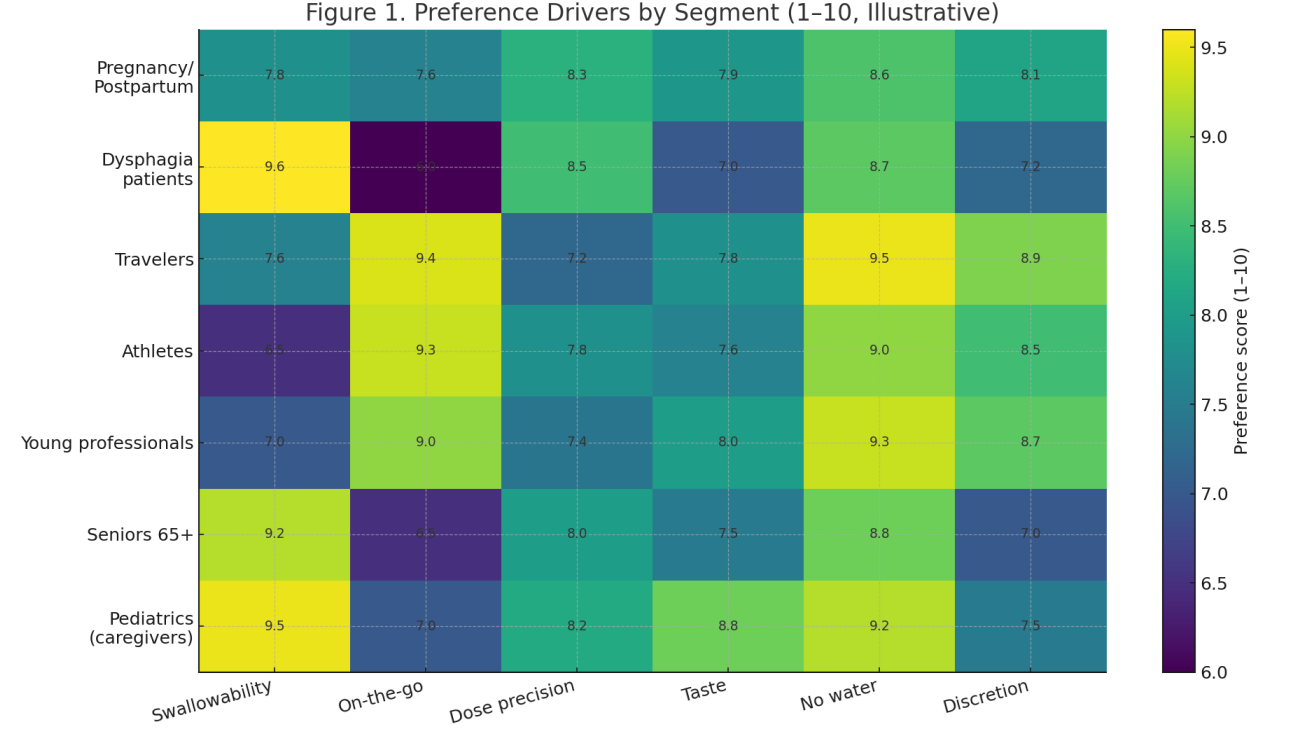
Persona modeling: defined seven segments and scored drivers on a 1–10 scale using expert heuristics and analog categories (Figure 1).
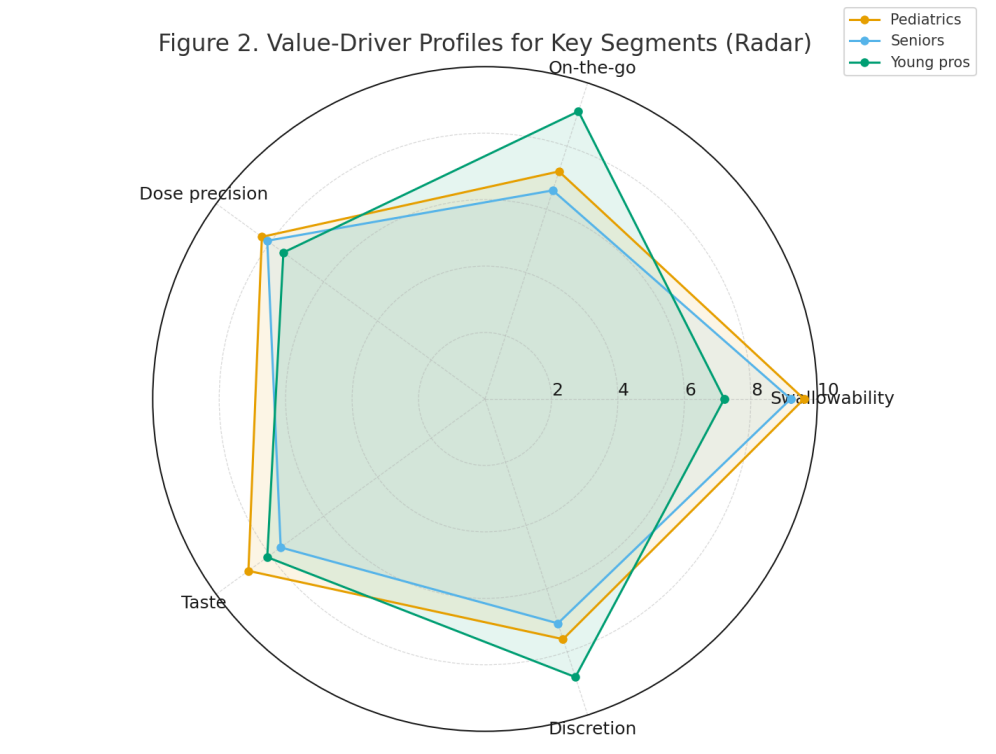
Value-driver comparison: radar profiles contrasted top candidate segments (Figure 2).
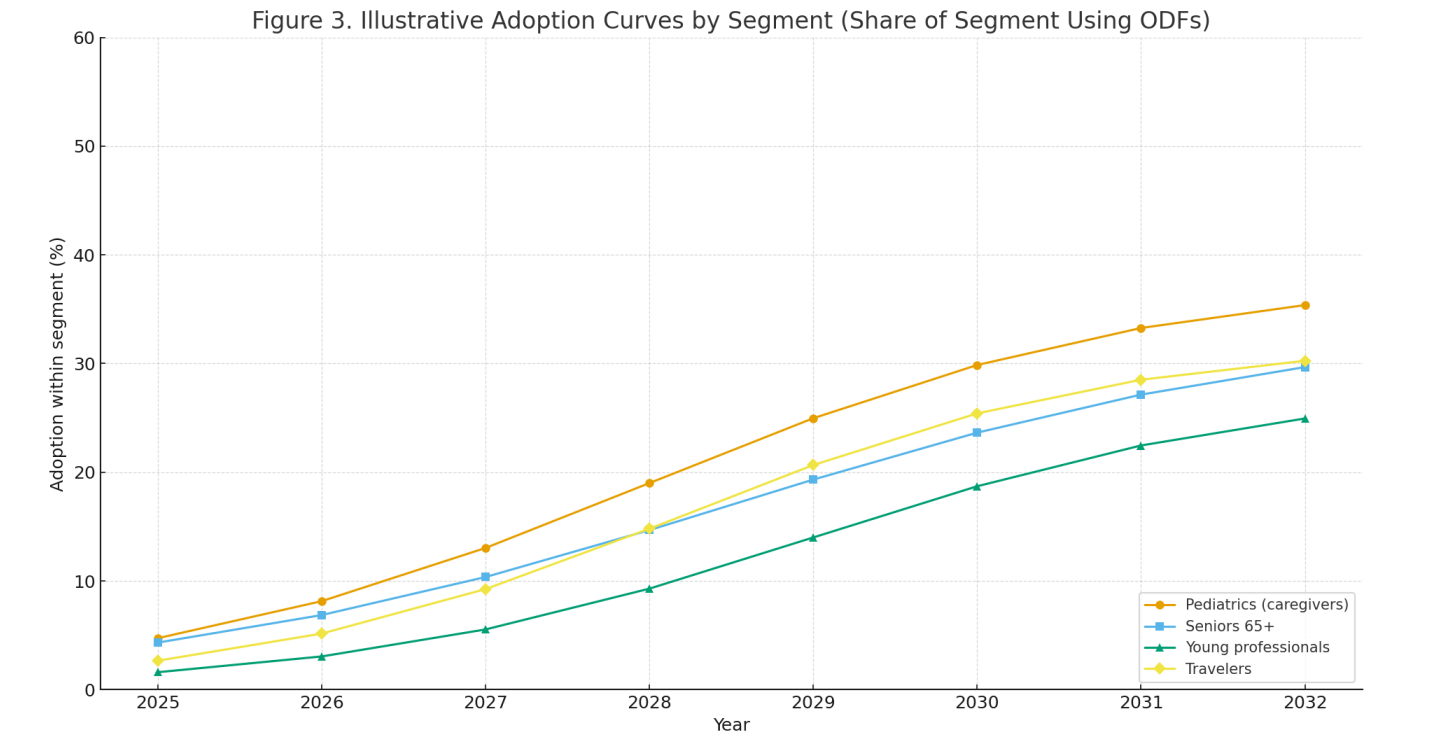
Adoption scenarios: logistic curves projected within-segment ODF usage share through 2032 to explore relative pacing (Figure 3).
Measures: preference scores, within-segment adoption (%), and qualitative needs (packaging, labeling, channels).
Measures
Preference score (1–10): per segment × driver.
Within-segment adoption (%): modeled share using ODFs.
Design cues: pack barrier, child resistance, font size/legibility, flavor profile.
Access indicators: pharmacy vs DTC suitability; caregiver involvement.
Results
Who prefers ODFs (Figure 1).
Pediatrics (caregivers): highest on swallowability and “no water”; also strong on taste.
Seniors 65+: high swallowability and dose precision; benefit from easy-open, larger-print packs.
Dysphagia patients: peak swallowability and dose precision needs.
Young professionals / Travelers / Athletes: strongest on on-the-go, discretion, “no water.”
Pregnancy/postpartum: balanced preference across precision, discretion, and taste.
How value differs (Figure 2). Pediatrics and seniors over-index on swallowability and dose precision; young professionals over-index on on-the-go and discretion while maintaining solid taste expectations.
Adoption pacing (Figure 3). Illustrative curves show pediatrics/caregivers leading early adoption, followed by seniors and travelers; young professionals rise later as DTC subscriptions and workplace use broaden access.
Design implications.
Pediatrics: child-resistant sachets, sugar-free sweeteners, friendly flavors.
Seniors/dysphagia: easy-open high-barrier sachets, large font, clear instructions.
Mobile segments: slim, sweat-resistant sachets; multi-stick secondary packs; subscription options.
Discussion
ODFs are chosen when swallowability or mobility dominates decision-making. For caregivers and seniors, seamless swallowability and precise dosing trump other features; for mobile adults, convenience and discretion are decisive. Packaging and labeling are not ancillary—barrier quality maintains stability, while usability (easy-open, legible) drives repeat choice. Evidence gaps include head-to-head adherence and biomarker outcomes versus tablets/gummies in each segment [2]. Ethical marketing should avoid youth appeal when nicotine/caffeine actives are involved and follow local regulations.
Conclusion
The groups most likely to choose ODFs are pediatrics (via caregivers), dysphagia patients, seniors, and highly mobile adults (young professionals, travelers, athletes). Their reasons cluster around swallowability, convenience, discretion, and dose precision. Products that pair high-barrier yet easy-open packaging with tasteful, sugar-sparing formulations—and are offered via both pharmacy and DTC—will best meet these segments’ needs.
References
[1] ICH Q8–Q10: Quality by Design, risk management, and pharmaceutical quality system.
[2] Adherence literature comparing alternative oral formats (tablets, gummies, sprays, films).
[3] USP/Ph. Eur. chapters on dosage form quality and packaging integrity.
[4] ASTM F1249/F1927: barrier characterization for packaging selection.
[5] Consumer health retail & e-commerce adoption trends for convenience formats.
[6] Taste-masking and pH micro-environment strategies for thin films (review articles).