Types of Products Suitable for Orodispersible Films and the Benefits They Bring
Author: Sihan Meng,Leyu Zhu,Pengcheng Shi
Affiliation: RSBM
Email: pengchengshi@biotechrs.com; pcspc9@gmail.com
Abstract
Orodispersible films (ODFs) enable water-free, fast-acting, and precise micro-dosing across consumer health and OTC categories. This paper proposes a framework to evaluate which product classes are best suited to ODFs—considering dose size, palatability, desired onset speed, moisture stability, and safety—and quantifies user and system-level benefits such as swallowability, portability, discretion, and dose precision. We synthesize a suitability matrix, compare benefit impact across representative categories, and position ODFs against tablets, gummies, and oral sprays using a benefit-versus-COGS lens. Results indicate strong fit for melatonin, antihistamines, antiemetics, vitamins/minerals, electrolytes, probiotics, and caffeine-containing consumer products, with the highest net benefit where low doses and rapid onset are valued [1–7].
Introduction
ODFs are thin polymeric strips that disperse on the tongue without water, offering discreet administration and rapid disintegration. As brands explore ODF extensions beyond traditional tablets and gummies, deciding which products belong on film is essential to avoid mismatch between formulation constraints (taste, load, moisture sensitivity) and user expectations (onset, convenience). We outline a practical decision framework and quantify benefits by category [1–4].
Methods
Category screening. Seven categories were profiled: melatonin, antihistamines, antiemetics, electrolytes, vitamins/minerals, probiotics, and caffeine (consumer).
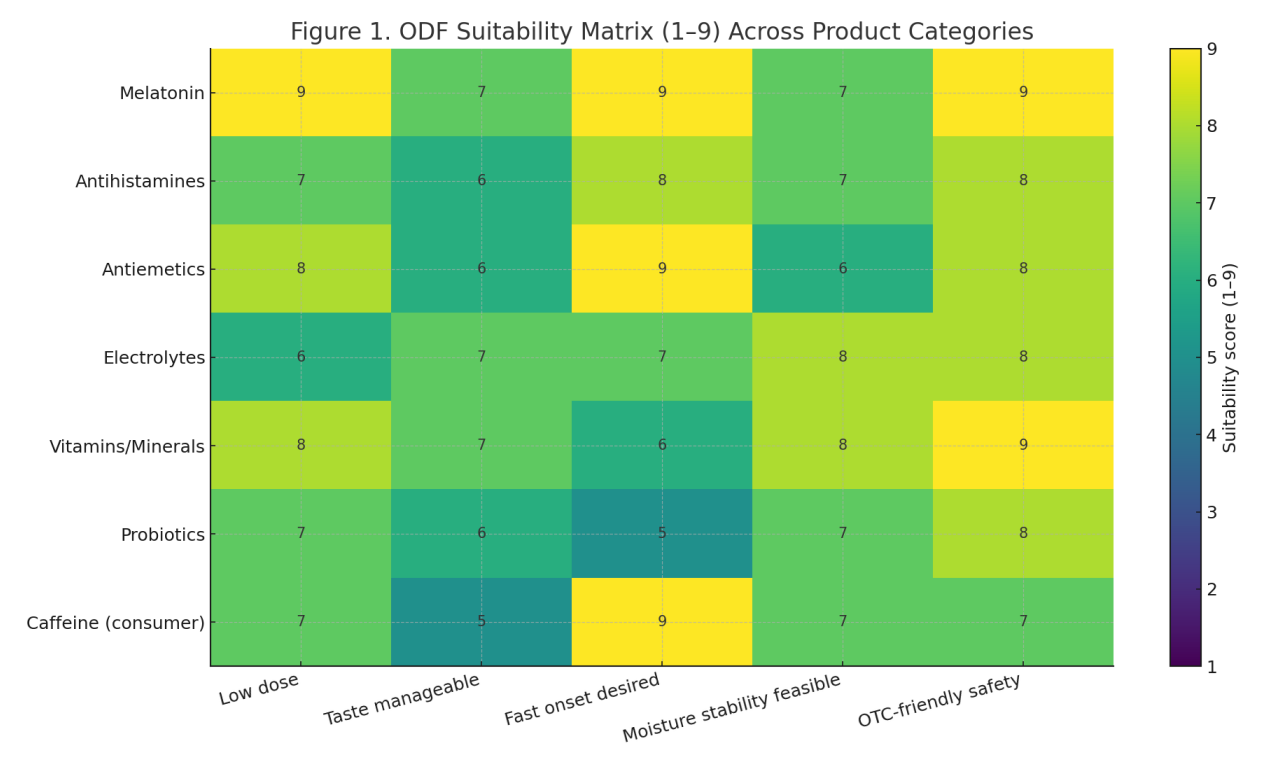
Suitability criteria. Five criteria were scored 1–9 based on literature and development heuristics: low dose, taste manageability, desired fast onset, feasible moisture stability, and OTC-friendly safety profile (Figure 1).
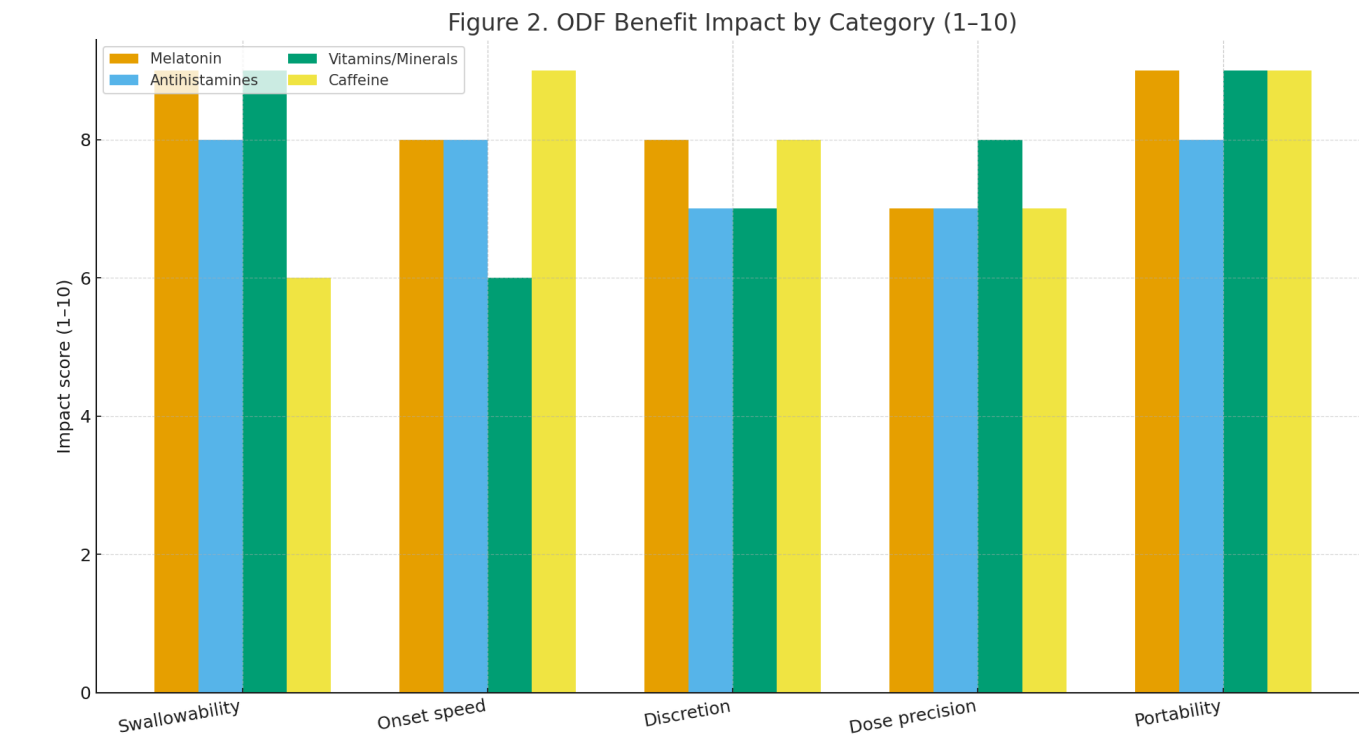
Benefit impact. For four representative categories, five user benefits (swallowability, onset speed, discretion, dose precision, portability) were rated 1–10 (Figure 2).
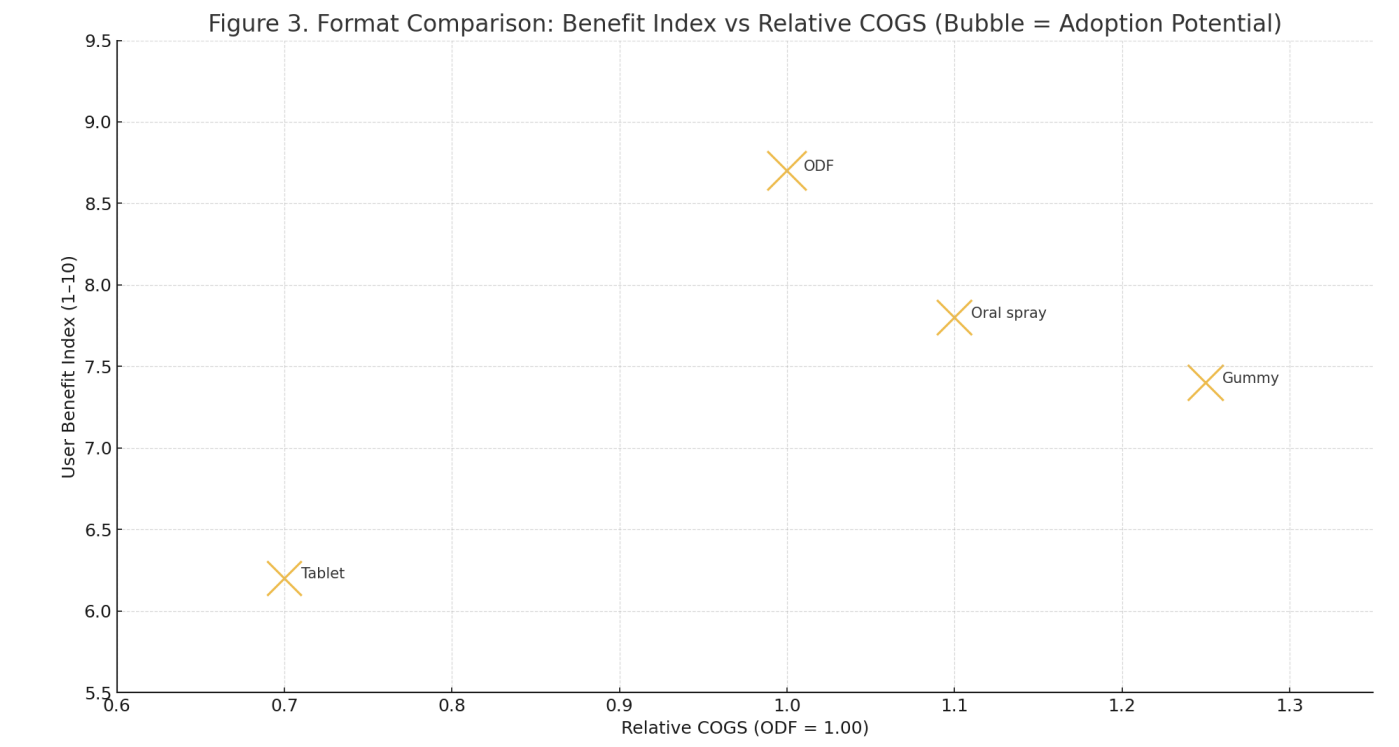
Format benchmarking. ODFs were compared with tablets, gummies, and oral sprays via a User Benefit Index (composite of the above benefits) versus relative COGS (ODF=1.00), with adoption potential shown as bubble size (Figure 3).
Measures. Disintegration time, thickness/content uniformity, taste panel scores, barrier needs (WVTR/OTR), and pack usability were tracked to anchor qualitative scores [2,5–7].
Measures
Technical: disintegration ≤60 s; thickness RSD ≤5%; content AV ≤15; residual moisture and a_w within spec.
User: 5-point Likert for taste and mouthfeel; reported convenience and discretion; perceived onset.
Economic: relative COGS by format; setup amortization per batch; packaging contribution to unit cost.
Risk/Compliance: labeling and age-appropriateness, data integrity for in-process controls.
Results
Suitability matrix (Fig. 1). Highest composite suitability observed for melatonin (low dose, fast onset), antiemetics (rapid onset value), and vitamins/minerals (micro-dosing and portability). Electrolytes are feasible for low-dose adjuncts or flavor tabs; probiotics require strict a_w control and barrier packaging; caffeine consumer benefits from discretion and speed but demands careful taste work.
Benefit impact (Fig. 2).
Melatonin: strong gains in swallowability, onset, and portability for bedtime dosing.
Antihistamines: high onset benefit and convenience for breakthrough symptoms.
Vitamins/Minerals: top scores on swallowability and portability, enabling micro-dose regimens.
Caffeine: leading onset and portability for on-the-go alertness; taste remains the constraint.
Format benchmarking (Fig. 3). ODFs deliver the highest user benefit index at moderate relative COGS (1.00). Tablets are cost-efficient but underperform on convenience; gummies offer mouthfeel but higher COGS and sugar load; sprays approach ODF in speed but may face dosing variability and packaging complexity.
System benefits. Across categories, ODFs reduced water dependency, improved adherence for swallow-averse users, and enabled discreet dosing in travel/work contexts.
Discussion
Where ODFs shine. Low-to-moderate dose actives with acute relief or bedtime use cases (melatonin, antiemetic, antihistamine) show the best benefit–risk–cost alignment. Foundational enablers include polymer blends (HPMC/PVA or pullulan), taste-masking (cyclodextrins, layering), micro-environment pH control, and high-barrier packs validated by ASTM F1249/F1927 [2,5–7].
Constraints. High drug loads (>30–40% w/w solids) stress content uniformity; intensely bitter/volatile actives demand advanced taste systems; moisture-sensitive categories require nitrogen-flushed foil laminates. Ethical marketing and age-appropriate labeling are essential for stimulant-containing consumer products.
Roadmap. Begin with feasibility screens on dose, taste, and barrier needs; confirm with small-scale stability (a_w, residual O₂) and user taste panels; then progress to DoE for disintegration/strength and to packaging trials in parallel.
Conclusion
ODFs are best applied to low-dose, fast-acting, and convenience-sensitive product types—melatonin, antihistamines, antiemetics, targeted vitamins/minerals, electrolytes (adjunct), probiotics (with strong barrier control), and caffeine consumer offerings. Compared with tablets, gummies, and sprays, ODFs deliver the strongest overall user benefits at competitive COGS when paired with proper taste-masking and barrier packaging. This framework helps teams triage opportunities and design ODFs that meaningfully improve adherence and user experience.
References
[1] ICH Q8–Q10: Pharmaceutical development, risk management, and quality system.
[2] USP/Ph. Eur. chapters on orodispersible films, content uniformity, and disintegration.
[3] Reviews of HPMC/PVA/pullulan film systems and plasticization for fast disintegration.
[4] Cyclodextrin complexation and multilayer taste-masking strategies for bitter actives.
[5] ASTM F1249/F1927: WVTR/OTR methods for packaging barrier selection and validation.
[6] Process analytical technology for moisture and thickness control in thin-film coating/drying.
[7] Consumer adherence studies on convenience formats (tablets, gummies, sprays, films).