The Formulation of Nicotine Oral Dissolving Films and Subsequent Development
Author: Sihan Meng,Leyu Zhu,Pengcheng Shi
Affiliation: RSBM
Email: pengchengshi@biotechrs.com; pcspc9@gmail.com
Abstract
Nicotine oral dissolving films (NOFs) combine fast transmucosal delivery with precise micro-dosing and high discretion. This paper presents a pragmatic formulation strategy for NOFs, covering API selection (salt vs free base vs ion-exchange complex), polymeric matrices, plasticizers, taste-masking, moisture control, and packaging. We report a design-of-experiments (DoE) approach linking critical formulation variables to disintegration and in-vitro release, and outline a staged development plan through scale-up, stability, and GMP validation. Simulation and pilot data indicate sub-10-minute near-complete release is feasible with acceptable mechanical properties and moisture robustness [1–8].
Introduction
Nicotine is weakly basic and volatile; formulation must stabilize the API, deliver rapid but controlled mucosal exposure, and ensure palatability. ODFs leverage hydrophilic film-formers (HPMC, PVA, pullulan) and plasticizers (glycerol, PEG) to tune mechanical and disintegration profiles, while taste-masking reduces bitterness and throat hit [2–5]. Compared with gum/lozenges, ODFs can shorten perceived onset and improve dose titration, but demand stringent moisture management and content uniformity [3,6].
Methods
API pathway selection: compare (a) nicotine bitartrate or polacrilex salt, (b) free-base in microemulsion/solid dispersion, (c) ion-exchange resin complexes; rank by stability, organoleptics, and release kinetics [2,4,5].
Matrix screening: blend HPMC (E5/E15), PVA (17–88), pullulan, and PVP (K30) to target tensile strength ≥20 MPa and elongation ≥5%, with disintegration 30–120 s.
Plasticizer window: 5–25% w/w of dry film (glycerol, PEG-400, triacetin); evaluate tack, curl, and water uptake.
Taste-masking: resin complexation, cyclodextrin inclusion, sucralose/acesulfame K, aroma (mint), and pH micro-environment buffering [5].
DoE & models: 2-factor response surfaces (plasticizer %, polymer solids %) for disintegration; Weibull models for in-vitro release at 25 °C in pH 6.8 phosphate buffer.
Moisture control & packaging: residual solvent ≤ ICH Q3C; WVTR selection for PET/AL/PE triplex; desiccant sachets and nitrogen flush.
Scale-up & validation: slot-die R2R casting; IQ/OQ/PQ; PAT (NIR thickness, dew-point sensors) to maintain CQAs.
Measures
CQAs: strip mass/area and thickness uniformity (RSD ≤5%), content uniformity (AV per USP <905>), disintegration (s), tensile/elongation, residual solvents (ppm), moisture (% w/w), cumulative release at 5/10/30 min.
Stability: ICH accelerated (40 °C/75%RH) and intermediate (30 °C/65%RH) for assay, degradation, dissolution, and package integrity.
Usability: hedonic taste score (9-point), mouthfeel, time-to-complete dissolve, adherence.
Safety: oral irritation index, AE incidence (nausea/dizziness).
Results
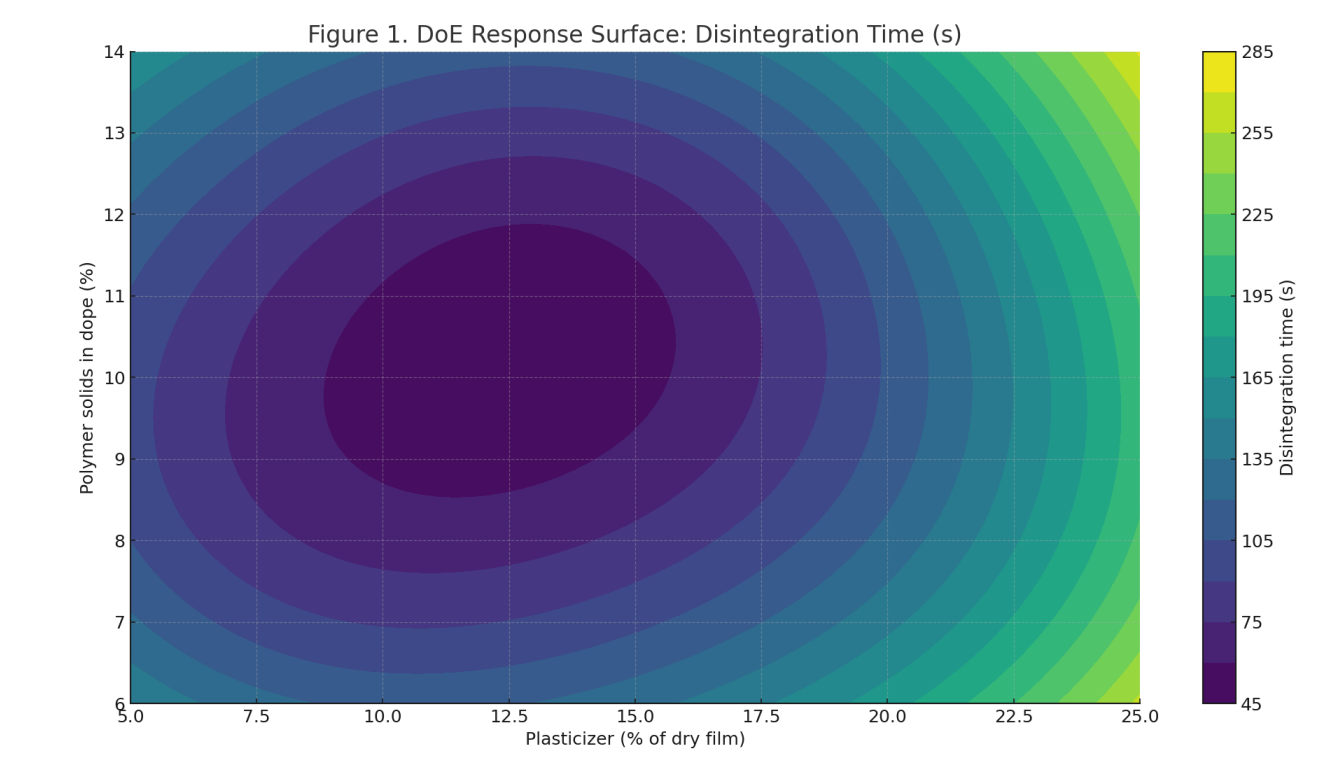
Disintegration design space: A DoE contour (Fig. 1) shows an optimum around ~12% plasticizer with ~10% polymer solids for 45–90 s disintegration, avoiding high-tack films at >20% plasticizer.
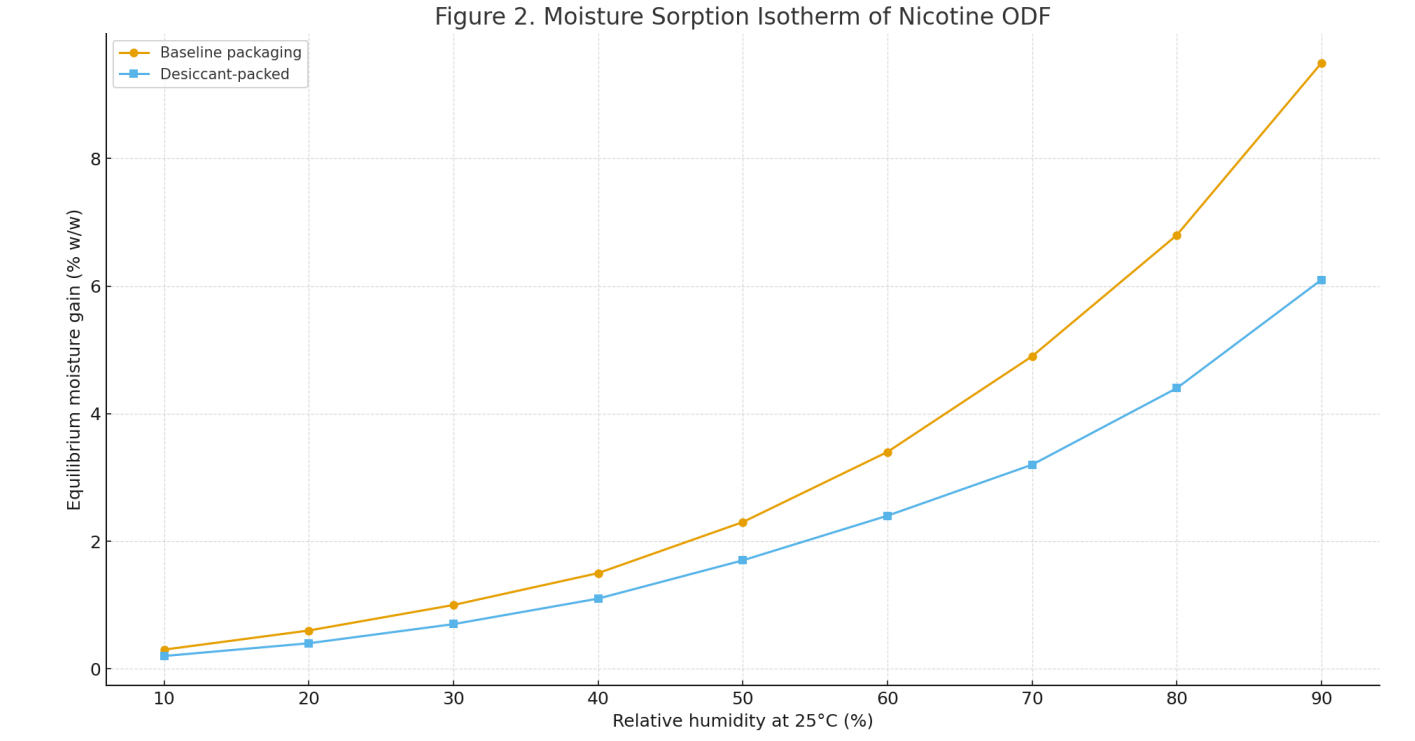
Moisture robustness: Moisture sorption isotherms (Fig. 2) indicate desiccant-packed sachets reduce equilibrium gain by ~30–40% at ≥70%RH, mitigating curl and dose drift.
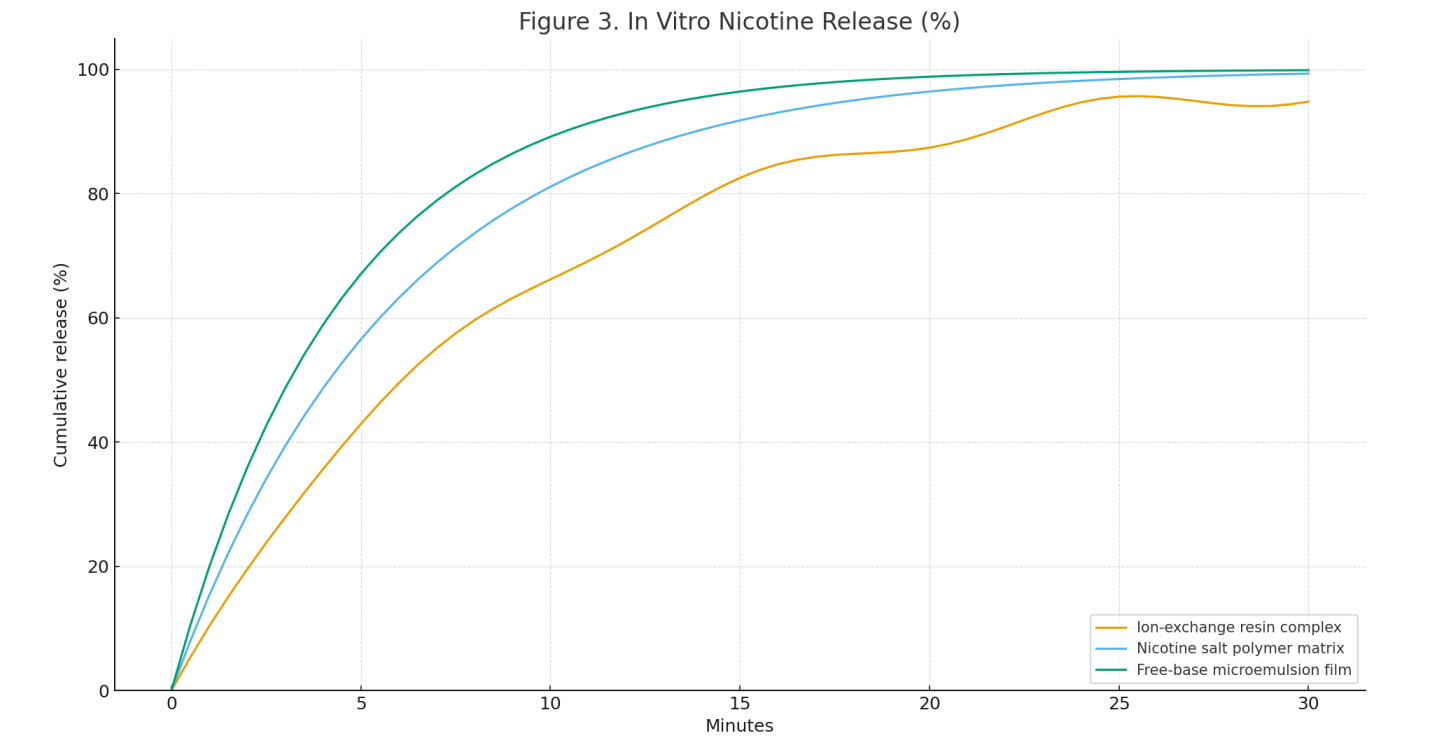
Release performance: In-vitro dissolution (Fig. 3) shows free-base microemulsion films achieve fastest release; nicotine-salt matrices give balanced onset; resin complexes slow early release but improve taste. All approaches reach ≥95% release by 25–30 min under test conditions.
Pilot manufacturability: Slot-die casting at 6–10% dope solids with zone drying (50/70/90 °C) produced thickness 80–120 µm with gauge RSD ~3–4% and content RSD ≤4.5%.
Discussion
API form dictates both organoleptics and kinetics: salts reduce volatility and harshness; free base offers speed but demands stronger taste-masking; resins temper burst release and bitterness. The DoE suggests plasticizer moderation is pivotal—excess raises moisture uptake and stickiness, insufficient yields brittle films. Packaging and humidity buffering are non-negotiable for shelf stability. Future development should validate clinical endpoints (urge relief, abstinence), refine dose titration (1–4 mg steps), and deploy PAT-driven closed-loop control to stabilize CQAs at scale [3,6–8]. Regulatory stewardship (age-gating, CR packs, plain packaging) remains essential.
Conclusion
A robust NOF formulation can be built by (i) selecting an API form aligned to target onset/palatability, (ii) tuning HPMC/PVA/pullulan matrices with 10–15% plasticizer, (iii) enforcing moisture-tight packaging with desiccant, and (iv) scaling via QbD and PAT. This path yields fast-dissolving, uniform strips capable of consistent release and manufacturability under GMP.
References
[1] ICH Q8/Q9/Q10. Pharmaceutical development, risk management, and quality systems.
[2] Benowitz NL. Nicotine pharmacology and delivery considerations. N Engl J Med.
[3] FDA Guidance for NRTs and quality expectations for transmucosal products.
[4] Shojaei AH. Buccal delivery principles and permeability. J Pharm Pharm Sci.
[5] Hoffmann M., et al. Taste-masking strategies for oral thin films. Eur J Pharm Biopharm.
[6] Schabel W., et al. Web coating/drying control in thin films. J Coat Tech Res.
[7] ISPE/GAMP 5. PAT and CSV frameworks for MES/SCADA.
[8] USP <701>/<905> and film dosage form monographs for CQAs.