Key Process Parameters Disclosure: Coating Volume, Drying Temperature Zone, Tension Control
Author: Sihan Meng, Leyu Zhu, Pengcheng Shi
Affiliation: RSBM
Email: pengchengshi@biotechrs.com; pcspc9@gmail.com
Abstract
In continuous coating and film-based manufacturing processes, a limited number of core process parameters exert a disproportionate influence on product quality, yield, and scalability. Among these, coating volume, drying temperature zoning, and web tension control form a tightly coupled triad that determines film uniformity, residual solvent content, mechanical integrity, and downstream process stability. This paper provides a structured disclosure and analysis of these three parameters, focusing on their physical meaning, interaction mechanisms, and measurable control windows. By consolidating academic literature and industrial practice, this study aims to provide a transparent reference framework for engineers and process developers seeking reproducible and scalable coating operations.
Introduction
Film coating and continuous web processing are widely applied in pharmaceuticals, nutraceuticals, functional materials, and advanced packaging. Despite differences in formulation and equipment design, process failures are frequently traced back to poor control of a small set of parameters rather than formulation chemistry alone [1].
Coating volume determines mass loading and thickness, drying temperature profiles govern solvent removal and microstructure formation, and tension control stabilizes web transport and dimensional accuracy. These parameters are often adjusted empirically, leading to hidden process risks and limited transferability between pilot and commercial scales. This paper emphasizes explicit parameter disclosure and mechanistic understanding as a foundation for robust process design.
Methods
A qualitative–quantitative review methodology was adopted. Peer-reviewed studies on slot-die, knife-over-roll, and gravure coating processes published between 2000 and 2024 were reviewed alongside industrial drying and web-handling references. Parameters were analyzed individually and then as an interacting system. Emphasis was placed on studies reporting measurable operating windows and failure modes related to coating non-uniformity, cracking, curling, or web breakage [2–4].
Measures
Three categories of parameters and their primary evaluation metrics were defined:
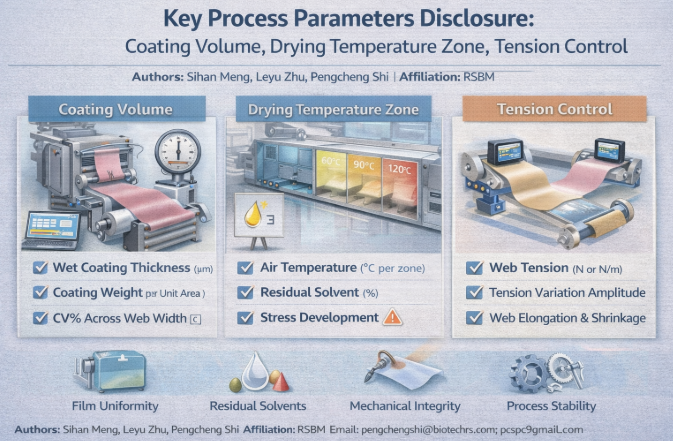
Coating volume
Wet coating thickness (µm)
Coating weight per unit area (g/m²)
Coefficient of variation (CV%) across web width [5]
Drying temperature zone
Zone-specific air temperature (°C)
Drying rate and residual solvent content (%)
Onset of skin formation or internal stress [6]
Tension control
Web tension (N or N/m)
Tension fluctuation amplitude
Web elongation and shrinkage behavior [7]
These measures allow correlation between process settings and final product attributes.
Results
Literature analysis shows that coating volume directly determines dose or functional loading but also amplifies sensitivity to drying conditions. Excessive coating volume combined with aggressive early-stage drying increases the risk of surface skinning and internal void formation [6].
Segmented drying temperature zones—typically low-to-moderate temperatures in the initial zone followed by higher temperatures downstream—were consistently associated with improved solvent release and reduced internal stress [3].
Tension control was found to be a hidden yet critical variable: insufficient tension led to web flutter and coating non-uniformity, while excessive tension caused thinning, neck-in, or micro-cracking after drying [7]. Stable tension profiles significantly reduced batch-to-batch variability even when coating volume fluctuated within acceptable limits.
Discussion
The three parameters examined do not operate independently. Coating volume defines the drying load, drying temperature zoning defines stress development, and tension control governs dimensional response to both. Optimizing one parameter in isolation often shifts instability to another part of the process.
From a process-transfer perspective, explicit disclosure of parameter ranges is more valuable than single-point “optimal” settings. Transparent parameter windows enable faster scale-up, more reliable troubleshooting, and clearer communication between formulation, equipment, and production teams [2,4].
Conclusion
Coating volume, drying temperature zoning, and tension control constitute the core controllable parameters in continuous coating processes. Their combined management determines film uniformity, mechanical integrity, and process robustness. This paper highlights the necessity of explicit parameter disclosure and systems-level optimization to move from empirical adjustment toward reproducible, scalable manufacturing. Establishing and documenting these parameter windows is essential for quality-by-design and long-term process stability.
References
Aulton ME, Taylor K. Aulton’s Pharmaceutics: The Design and Manufacture of Medicines. 5th ed. Elsevier; 2018.
Scriven LE. Physics and applications of dip coating and spin coating. MRS Proc. 1988;121:717–729.
Kistler SF, Schweizer PM. Liquid Film Coating. Springer; 1997.
Ruschak KJ. Limiting flow in slot coating dies. J Appl Mech. 1976;43(1):187–191.
Yuan H, et al. Uniformity control in thin film coating processes. Chem Eng Sci. 2012;73:168–176.
Mujumdar AS. Handbook of Industrial Drying. 4th ed. CRC Press; 2014.
Shelton JJ. Web Handling and Converting. Wiley; 2015.