Batch Consistency Control: How to Manage Weight, Content, and Size Deviations
Author: Sihan Meng, Leyu Zhu, Pengcheng Shi
Affiliation: RSBM
Email: pengchengshi@biotechrs.com; pcspc9@gmail.com
Abstract
Batch consistency is a central quality requirement for Oral Disintegrating Films (ODFs), where dose accuracy is determined by a combination of film thickness, area, and formulation homogeneity rather than by unit weight alone. Deviations in weight, content, and size are common failure modes during scale-up and mass production, often resulting from inadequate control of upstream processes and converting operations. This paper presents a systematic approach to batch consistency control in ODF manufacturing, focusing on the mechanisms that generate variability and the practical strategies used to manage weight, content, and dimensional deviations. By linking critical process parameters to measurable quality outcomes, this study provides a framework for achieving reproducible, compliant, and scalable production.
Introduction
Unlike tablets or capsules, Oral Disintegrating Films are continuous dosage forms that are converted into individual units after coating and drying. As a result, batch consistency is not governed by a single filling or compression step, but by the cumulative stability of formulation, coating, drying, slitting, and die-cutting processes [1].
Inconsistent batches often manifest as failures in content uniformity, visual non-uniformity, or regulatory non-compliance. Importantly, these deviations rarely originate from a single error; rather, they reflect insufficient system-level control [2]. This paper analyzes batch consistency from a process engineering perspective and outlines strategies to manage weight, content, and size deviations in ODF production.
Methods
A process-oriented analysis was conducted using peer-reviewed literature, pharmacopeial guidance, and industrial ODF manufacturing experience. Sources of variability were classified according to formulation-related factors, process-related factors, and converting-related factors. Control strategies were mapped to each category, and consistency was evaluated through standard quality metrics used in oral film manufacturing [3].
Understanding Consistency in ODF Manufacturing
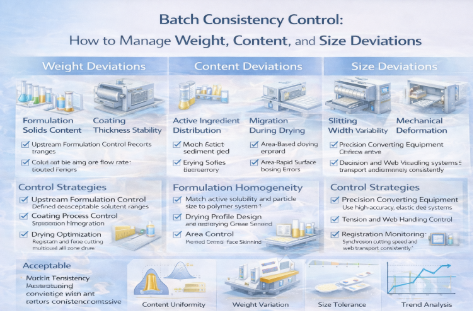
Weight, Content, and Size: Interconnected Variables
In ODFs, these three parameters are interdependent:
Weight reflects film thickness, density, and residual moisture.
Content depends on formulation homogeneity and area-based dosing.
Size defines the cut area, directly influencing dose per unit.
Managing any one variable in isolation is insufficient [4].
Sources of Weight Deviation
Formulation Solids Content
Variations in solids concentration alter wet film thickness and final dry weight. Inadequate mixing or solvent evaporation during holding can cause drift over time [5].
Coating Thickness Stability
Fluctuations in coating gap, pump rate, or viscosity lead to weight variability across the web and between batches.
Residual Moisture Variability
Inconsistent drying results in variable retained moisture, which directly affects unit weight measurements [6].
Sources of Content Deviation
Active Ingredient Distribution
Poor solubility, sedimentation, or phase separation during coating leads to content non-uniformity even when weight is consistent.
Migration During Drying
Inappropriate drying profiles may cause active migration toward the surface or edges, creating localized concentration differences [7].
Area-Based Dosing Errors
Any deviation in cut size directly translates to content deviation, regardless of formulation quality.
Sources of Size Deviation
Slitting Width Variability
Inaccurate or unstable slitting introduces width errors that propagate through downstream die-cutting.
Die-Cutting Registration Errors
Misalignment between film web speed and die motion causes inconsistent unit dimensions.
Mechanical Deformation
Elastic stretching or shrinkage of the film under tension alters final dimensions after cutting [8].
Control Strategies for Weight Consistency
Upstream Formulation Control
Define acceptable solids content ranges
Limit solution holding time
Use controlled agitation to prevent concentration drift
Coating Process Control
Stabilize coating gap and flow rate
Monitor viscosity in real time where possible
Drying Optimization
Implement multi-zone drying to achieve uniform residual moisture
Define a target moisture window rather than absolute dryness [9]
Control Strategies for Content Uniformity
Formulation Homogeneity
Match active solubility and particle size to polymer system
Prevent sedimentation through viscosity and agitation control
Drying Profile Design
Avoid rapid surface skinning
Minimize concentration gradients during solvent removal
Area Control
Tight tolerance control of die geometry and cutting alignment [10]
Control Strategies for Size Consistency
Precision Converting Equipment
Use high-accuracy slitting and die-cutting systems
Maintain sharp tooling and replace worn dies proactively
Tension and Web Handling Control
Minimize elastic deformation
Use closed-loop tension control where possible
Registration Monitoring
Synchronize cutting speed and web transport consistently [11]
Measures
Batch consistency is evaluated using the following indicators [12,13]:
Unit weight variation (RSD)
Content uniformity testing
Dimensional tolerance compliance
Yield after converting and packaging
Batch-to-batch trend analysis
These measures provide early detection of systemic drift rather than isolated defects.
Results
Manufacturing experience shows that consistent control of coating thickness, residual moisture, and cut area dramatically reduces batch variability. Facilities employing integrated control strategies achieve lower rejection rates, improved regulatory compliance, and higher customer confidence. In contrast, reactive inspection-based control fails to prevent recurring deviations [14].
Discussion
Batch consistency in ODF manufacturing is fundamentally a process design challenge rather than a testing challenge. Reliance on end-product inspection alone increases cost and scrap without addressing root causes. Effective consistency control requires early identification of critical process parameters and disciplined adherence to defined operating windows.
For OEM/ODM environments, transparent consistency control is also a key differentiator, enabling reliable delivery schedules and scalable partnerships [15].
Conclusion
Managing weight, content, and size deviations in Oral Disintegrating Film production requires a system-level approach that integrates formulation stability, process control, and precision converting. Batch consistency is achieved not through tighter inspection alone, but through robust process design and disciplined execution. Manufacturers that adopt these principles can achieve reproducible, compliant, and economically sustainable ODF production at scale.
References
Fu Y et al. Expert Opin Drug Deliv. 2004;1(4):673–690.
Preis M. J Pharm Pharmacol. 2013;65(2):157–170.
Cilurzo F et al. Eur J Pharm Biopharm. 2008;70(3):895–900.
Dixit RP, Puthli SP. J Control Release. 2009;139(2):94–107.
Bala R et al. Int J Pharm Investig. 2013;3(2):67–76.
Hoffmann EM et al. Pharm Res. 2011;28(8):1914–1922.
Borges AF et al. Int J Pharm. 2015;494(1):332–339.
Kistler SF, Schweizer PM. Liquid Film Coating. Chapman & Hall; 1997.
Sperling LH. Introduction to Physical Polymer Science. Wiley; 2005.
Morales JO, McConville JT. Ther Deliv. 2011;2(5):637–646.
Schmitt M et al. Coating Technology Handbook. CRC Press; 2016.
USP <905> Uniformity of Dosage Units.
USP <701> Disintegration Test.
Keshari R, Keshari S. J Drug Deliv Ther. 2014;4(4):1–7.
Preis M. Drug Dev Ind Pharm. 2013;39(7):1049–1057.