Cracking, Tearing, or Sticky in the Mouth? How to Choose Film-Formers and Get the Right Ratio for Oral Thin Films
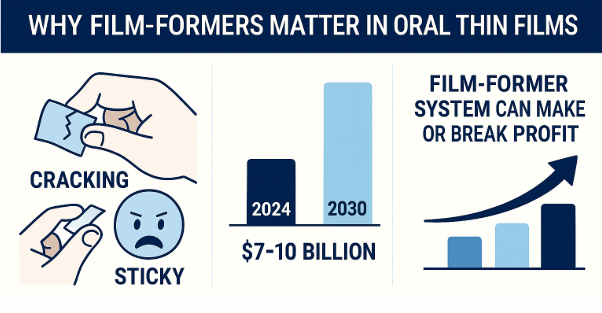
By 2024, the global oral thin film / oral dissolving film (ODF, orodispersible film) market is already worth around USD 3–4 billion. Most reports predict it will reach USD 7–10 billion by 2030–2035, with a CAGR of about 8–11%.
This is not a “tiny niche gadget” – it’s a rapidly expanding market.
Within this market, here’s how you can make money:
Factory owners / manufacturers
Build robust ODF formulation + ODF production line know-how around the film-forming system.
Sell “stable quality + low rework rate” as your main value in OEM/ODM projects, earning from processing fees and long-term orders.
Brand owners
With the right film-former choice and ratios, you can make oral thin films that don’t crack, don’t stick, and dissolve quickly with a good mouthfeel.
That makes your products feel “premium” both on the shelf and in the user’s hand, supporting higher pricing and repeat purchase.
Traders / intermediaries
If you understand the logic of film-formers and ratios, you can answer questions like
“Why is your oral dissolving film more stable?”You can explain the film-forming polymer system professionally and become the project owner, instead of just competing on price.
This article uses five “golden points” to help you fully understand:
Why film-formers determine whether you make money or lose it.
The key metrics behind the “toughness vs. disintegration” balance.
The personality and use cases of common film-former systems.
Practical ratio ranges (for film-formers, plasticisers and other solids).
Concrete action advice for factories, brands and traders.
We end with a FAQ that addresses the most common questions.
I. Golden Point 1: Film-Formers Are the Invisible Ceiling on Your Profit
An oral dissolving film looks like “just a tiny strip”,
but the thing that most directly decides whether you make or lose money is not the API – it’s the film-forming polymer:
Wrong choice / bad ratios → “can’t be slit, can’t be wound, can’t be packed”
Cracks when peeled: fresh-coated film already has edge cracks and fractures, slitting and die-cutting scrap rate explodes.
Breaks when bent: web breaks during rewinding, whole rolls scrapped.
Sticky in mouth: terrible user experience, repeat purchase collapses.
Behind that are three very visible money flows:
Yield – more scrap means higher unit cost.
Line efficiency – endless adjustments and rework kill your real capacity.
Word of mouth & repeat purchase – if the film is brittle, sticky or dissolves poorly, the brand can’t really scale and you’re stuck doing “one-shot deals”.
In short:
You think you’re selling “function + mg dose”.
But what actually decides whether you reach tens or hundreds of millions of films per year
is often this: did you choose and balance the film-former system correctly?
II. Golden Point 2: What Does “Balancing Toughness and Disintegration” Really Mean?
Regardless of whether you use HPMC, PVA, pullulan or others, the core tension in oral films is:
Tough enough not to break in production and logistics,
yet fast and clean enough in-mouth so users don’t complain.
You can break this down into measurable metrics:
Mechanical properties
Tensile strength, elongation at break, tear strength.
Practical meaning: the web must not crack or crumble during coating, drying, rewinding, slitting, punching, packing and transport.
Disintegration performance
Time to complete disintegration in the mouth (e.g. 10–30 seconds).
Whether there is noticeable residue, “gluey” feel or stringiness.
Processability
At a given solids level, is solution viscosity suitable for slot-die / comma coating?
Does the dried film tend to curl, block or stick during rewinding?
Sensory & appearance
Gloss, transparency, softness.
With too much glycerol/PEG: does it feel overly sticky, greasy or floppy?
The trade-off you’re managing is:
Very high toughness
Often achieved with higher molecular weight or more tightly interacting polymers →
Disintegration tends to slow down and oral residue can increase.
Very fast disintegration
Achieved via highly soluble polymers and/or thinner films →
Mechanical strength may become insufficient: cracking and tearing issues.
So the real game is:
Adjusting polymer type + ratio + plasticiser + solids loading + drying profile
until you find a “comfort zone” that fits your product.
III. Golden Point 3: “Personality Profiles” of Common Film-Former Families
Below are the most common film-forming polymers in oral thin films, naturally including SEO terms like
HPMC, PVA, pullulan, PVP, CMC-Na, gelatin.
1. HPMC (Hydroxypropyl Methylcellulose)
Features:
One of the main film-formers for oral thin films.
Balanced mechanical and disintegration performance.
Many viscosity grades, making rheology easy to tune.
Best for:
Health-supplement ODF formulations (vitamins, melatonin, botanicals, etc.).
Oral thin films that need a transparent or semi-transparent look.
2. PVA (Polyvinyl Alcohol)
Features:
Strong film, high toughness.
Disintegration speed acceptable but may be on the slow side unless combined.
Sensitive to drying conditions – can curl if poorly dried.
Best for:
Lines that require high mechanical strength (higher speed, wider web, high tension rewinding).
Combination with HPMC/pullulan to boost strength while keeping reasonable disintegration.
3. Pullulan
Features:
Very good mouthfeel, high transparency, fast dissolution.
More expensive.
Mechanical strength moderate; needs help from PVA/HPMC or higher plasticiser levels.
Best for:
“Premium look + high transparency” oral dissolving films.
Products needing fast disintegration (breath fresheners, energy strips, etc.).
4. PVP and related cellulose/polysaccharide helpers
Often used as auxiliary polymers: improve solubility, compatibility with APIs.
Common in high-load APIs or solid dispersion systems.
5. Gelatin / CMC-Na and others
In some markets or formulations, gelatin or sodium CMC is still used:
Gelatin tastes good but is sensitive to temperature and humidity, and has religious/vegan constraints.
CMC-Na is more of a supporting excipient to stabilise the system.
Takeaway:
In practice, the best systems are usually two- or three-polymer blends + a sensible plasticiser package, not a single polymer.
The goal is to find a combination of:
“Main structural backbone + dissolution accelerator + sensory adjuster”
that fits the regulatory and market context.
IV. Golden Point 4: Practical Ratio Ranges (Film-Formers & Plasticisers)
Note: everything below is an experience-based range, not a regulatory standard.
Every formulation still needs lab and pilot verification.
1. Total solids (on a dry basis)
For most slot-die or comma-coated oral films:
20–40% total solids in the wet formulation is common.
Too low: films are too thin and weak.
Too high: viscosity skyrockets, coating becomes difficult, with streaks and sagging.
2. Total film-formers (as % of dry solids)
Typically 40–70% of dry solids:
40–50%:
Softer film, fast disintegration but less strength.
50–60%:
Balanced mechanical and dissolution performance.
60–70%:
High mechanical strength, but watch dissolution and mouthfeel.
Example two-polymer systems (percent of dry solids)
HPMC + PVA general-purpose system
HPMC: 25–35%
PVA: 15–25%
Total film-formers: 40–60%
Pullulan + HPMC high-end transparent system
Pullulan: 25–40%
HPMC: 15–25%
Total: 40–60%
High-strength ODF (industrial style or high load)
PVA: 25–40%
HPMC / other: 15–25%
Total: 50–70%
3. Plasticiser ratio range
Common plasticisers: glycerol, PEG 400, propylene glycol, sorbitol, maltitol, etc.
Generally 10–30% of the film-former mass:
<10%: films are brittle and crack easily.
15–25%: “comfort zone” for many formulations.
30%: films may become too soft, sticky and prone to blocking.
Example combinations
HPMC-dominant systems:
Glycerol 15–25% of HPMC mass;
Or glycerol + PEG 400, each 8–12%.
PVA-dominant systems:
Propylene glycol / glycerol 10–20%;
Must be tuned with drying to avoid curling and blocking.
Pullulan-dominant systems:
Around 20% glycerol plus small amounts of other polyols to give softness and mouthfeel.
4. Impact of APIs and other excipients
High-load APIs
May account for 20–40% of dry solids.
You need to raise the percentage of film-formers or optimise the blend to maintain strength.
Large amounts of sweeteners / polyols
These also act as plasticisers.
You can reduce separate plasticiser levels, otherwise the film becomes too soft.
Practical tip:
In development, test at least 3–5 ratio points:
e.g. film-formers at 45%, 55%, 65% of dry solids;
plasticisers at 15%, 20%, 25% of film-former mass.
For each point, evaluate:
Tensile, bend, tear (simple instruments + hand feel).
Disintegration time and mouthfeel.
Coating and rewinding behaviour.
V. Golden Point 5: Different Playbooks for Factories, Brands and Traders
1. For factories: build film-former choices into your standard message
Make a one-page chart:
X-axis: target (toughness priority / balanced / fast-disintegration & mouthfeel).
Y-axis: typical film-former combinations and plasticiser ranges.
In proposals or project calls, you can say:
“For your oral dissolving film project,
we suggest an HPMC + PVA system with 50–60% film-formers in solids
and a 15–20% plasticiser level to balance toughness and fast disintegration.”This makes clients feel you have real ODF formulation know-how, not just “we’ll try something in the lab”.
2. For brand owners: lock the requirements before discussing the film system
Answer a few questions first:
Are you more afraid of cracking or of slow, sticky disintegration?
Are film size and thickness tightly constrained (e.g. ultra-small strip)?
Who is the target user (children, elderly, quick energy, breath freshening, etc.)?
Put this into your brief and then let the factory / formulator propose a film system –
instead of saying “you guys just formulate something that works”.
3. For traders / intermediaries: use film-former logic to build authority
When discussing oral thin film OEM/ODM, casually add something like:
“The film-forming polymer system is key for toughness and disintegration.
We usually work with HPMC + PVA or pullulan-based systems within defined ratio ranges.”
When a client asks “Why do some films crack and some are too sticky?”,
you can explain it from the angle of film-former ratio + plasticiser level + drying profile
and emphasise that you will help choose factories and control process to improve success rate.
That positions you as a partner who understands process, not just a PI sender.
FAQ: Common Questions About Film-Former Choice and Ratios
Q1: Can I just use a single film-former and crank up the ratio?
You can, but it’s rarely optimal.
A single polymer trying to be both “very tough and very fast-dissolving” often forces compromises in thickness or plasticiser.
Two- or three-polymer blends often deliver better overall performance at a lower total level.
Q2: Why does the lab prototype look great, but the full-scale batch cracks on the line?
Typical reasons:
Lab coating method and drying conditions differ from the production line.
Large-roll tension and diameter amplify internal stress.
Lab ratios didn’t account for long-term storage and batch-to-batch variation.
Solution:
Do pilot runs under real line conditions.
Specifically test how different film-former ratios affect curl and cracking.
Q3: The more plasticiser, the better the film – right?
No.
10–30% (of film-former mass) is a common working range.
Beyond a certain point, you get:
Sticky, cold-flowing films that pick up marks easily.
Greasy mouthfeel and possibly stability issues.
Q4: If I want “instant disintegration”, should I just minimise the film-former level?
Not recommended.
Ultra-low film-formers with very thin films can accelerate disintegration, but:
Mechanical strength is poor, with lots of scrap in production and packaging.
Consumers will easily break the film in their hands.
Better approach:
Use more soluble polymers as part of the blend.
Optimise thickness and plasticiser levels.
Design the disintegration curve, not just slash polymer content.
Q5: Are film systems different for pet ODF and human ODF?
The principles are the same, but priorities differ:
Pet products emphasise mechanical strength and stability (rougher handling and feeding).
Human / beauty products emphasise mouthfeel, transparency and disintegration.
So ratio ranges can be similar, but optimisation priorities change.
Q6: As a trader, I don’t have a lab. How do I use this knowledge to win more deals?
You don’t need to formulate yourself. Instead:
Understand the client’s pain points (cracking, stickiness, slow disintegration).
Speak both “languages”: talk film-former ratio and plasticiser levels with factories,
then translate that into “less rework, better mouthfeel, more reliable lead time” for clients.
That’s how clients start to see you as a process-savvy partner, not just a middleman forwarding emails.