Inside a GMP ODF Factory: What Real Compliance Looks Like
Author: Sihan Meng,Leyu Zhu,Pengcheng Shi
Affiliation: RSBM
Email: pengchengshi@biotechrs.com; pcspc9@gmail.com
Abstract
Oral dissolving films (ODFs) are no longer experimental: they are commercialized in regulated markets for nutraceuticals, OTCs, and medicines. As the format matures, regulators and brand owners expect ODF plants to meet the same Good Manufacturing Practice (GMP) rigor as other solid and semi-solid oral dosage forms—while managing unique risks in web coating, drying, slitting, and unit-dose packaging. This paper defines what real compliance looks like inside a modern GMP ODF factory: from facility and HVAC design, material and data flows, and line-level controls to cleaning validation, change management, and ongoing verification. We outline practical methods, measurable indicators, and typical failure modes, using risk-based principles informed by ICH Q8/Q9/Q10, EU GMP, and FDA expectations. The aim is to distinguish cosmetic “GMP-flavored” marketing from verifiable, inspection-ready operations. [1–6]
Introduction
ODFs combine:
Thin polymeric drug product matrices,
Continuous web-based manufacturing,
Complex taste-masking and moisture control,
Precise unit-dose conversion and packaging.
This makes them:
Attractive for patient-centric and consumer-friendly products,
Non-trivial from a GMP standpoint.
Common misconceptions:
“It’s just a supplement strip, so food-grade is enough.”
“If the coater is clean and we test the final strips, we are GMP-compliant.”
“Documentation can be built later, once sales grow.”
Regulators, serious brand owners, and due-diligence teams think differently. A real GMP ODF factory:
Embeds quality-by-design (QbD),
Integrates facility, utility, equipment, process, and lab controls,
Demonstrates data integrity and traceability,
Produces reproducible product that stands up to audits and market complaints.
This paper provides a structural view of such a factory.
Methods
We describe compliance as an integrated system across nine domains:
Facility & HVAC/Humidity control
Material & personnel flows
Equipment & line qualification
Process design & control strategy
Cleaning & cross-contamination control
Laboratories & stability program
Documentation, data integrity & e-systems
Change control, deviations & CAPA
Vendor, outsourcing & inspection readiness
For each domain we:
Align with recognized GMP frameworks (e.g., ICH Q8/Q9/Q10, EU GMP, 21 CFR Parts 210/211 where applicable).
Translate them into specific expectations for ODF processes.
Define measures that distinguish robust systems from box-ticking.
(Note: Examples apply to both medicinal ODFs and high-quality nutraceutical ODFs; exact legal obligations depend on classification and jurisdiction.)
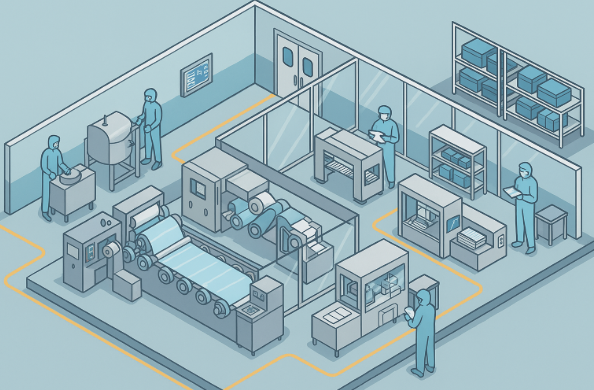
1. Facility & Environmental Control
A compliant ODF facility is engineered, not improvised.
Key elements:
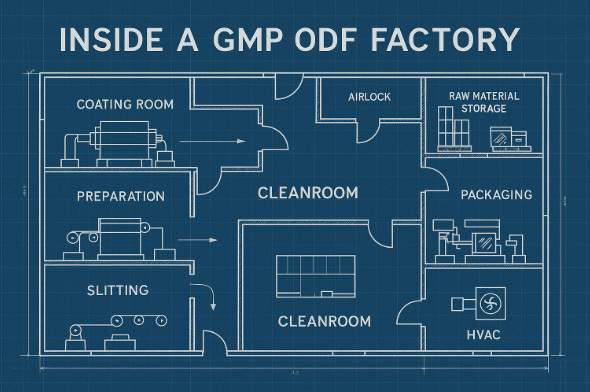
Segregated zones for:
Raw material storage,
Weighing/dispensing,
Solution preparation,
Coating & drying,
Slitting/die-cutting,
Primary & secondary packaging,
Finished goods.
Controlled temperature and relative humidity:
Typical: 20–24°C with defined RH (often 30–40% in critical areas) to protect film integrity.
Pressure differentials:
Clean → less clean; clear cascades between production, corridors, and technical areas.
Dedicated HVAC/AHU for critical zones to avoid cross-contamination and uncontrolled moisture.
Superficial compliance: painted floors and HEPA filters.
Real compliance: documented URS, design qualification (DQ), mapping, monitoring, alarms, trend review, and CAPA when excursions occur. [2,3,5]
2. Material & Personnel Flows
Material and people movement is where cross-contamination and mix-ups are born.
Expectations:
One-way or logically segregated flows for:
APIs, excipients, printed foils, and consumables.
Defined airlocks and gowning procedures per zone.
Visual and labeling control:
Status labels,
Line clearance checklists,
Clear segregation of quarantined vs released materials.
Real compliance is visible in how intuitive (and enforced) these flows are on any random day.
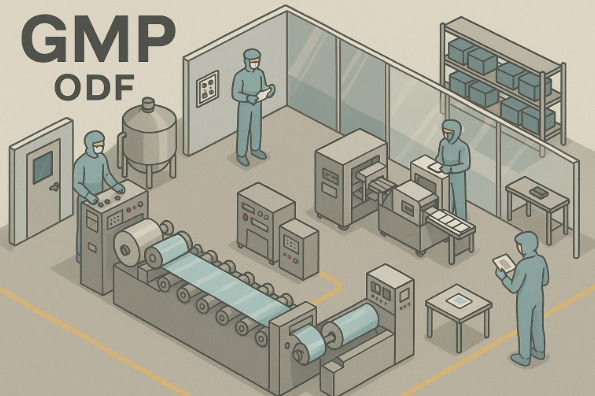
3. Equipment & Line Qualification
ODF manufacturing relies on:
Solution prep vessels,
Coaters/dryers,
Web-handling systems,
Slitters/die-cutters,
Sachet/blister/cartoning lines.
GMP expectations:
User Requirement Specifications (URS) tied to ODF risks (viscosity, uniformity, drying, tension).
IQ/OQ/PQ:
IQ: installation documented.
OQ: speeds, temperatures, tensions, alarms, interlocks challenged.
PQ: reproducible product at routine conditions.
Preventive maintenance, calibration, and change control.
A “tourist” plant points at shiny machines.
A compliant plant shows traceable qualification packages and live records.
4. Process Design & Control Strategy
For ODFs, process understanding is a compliance pillar:
Defined Critical Quality Attributes (CQAs):
Assay & content uniformity,
Disintegration time,
Mechanical strength,
Residual solvent/moisture,
Microbiological quality (where applicable),
Appearance and labeling.
Linked Critical Process Parameters (CPPs):
Solution solids & viscosity,
Coating weight,
Dryer zone temps, airflows, residence time,
Web tension and speed,
Slitting/die-cut alignment,
Sealing parameters.
Real compliance:
Documented design space and proven acceptable ranges,
In-process controls (IPCs) built into batch records,
Trend analysis and reaction plans.
Testing quality into the product is not enough; you must demonstrate control of how it is made. [1,3]
5. Cleaning & Cross-Contamination Control
Thin films + shared equipment + potent or bitter actives = high risk if cleaning is weak.
Key expectations:
Written cleaning procedures specific to:
Coaters, dryers, rollers, slitters, packaging lines.
Validated cleaning:
Swab/rinse methods,
Worst-case products (high potency, low MACO, sticky, colored, flavored).
Visual inspection plus analytical limits.
Controls for flavors and strong sweeteners that can bleed into subsequent products.
Real compliance:
If you ask, “Show me cleaning validation for this line,” they can. Quickly.
6. Laboratories & Stability Program
GMP ODF factories must prove initial and ongoing quality.
Core elements:
Qualified labs (in-house or contracted) for:
Assay, uniformity,
Identification, related substances (as applicable),
Microbiology where relevant,
Residual solvent, moisture.
Method validation or verification.
Stability program:
ICH-like conditions appropriate to classification,
On-market batch coverage,
Data confirming shelf-life in final pack. [4]
“Real compliance” means stability is not retrofitted when a customer asks; it is an integral program.
7. Documentation, Data Integrity & e-Systems
If it’s not documented, it did not happen.
Expectations:
Controlled SOPs, specs, batch records, and logbooks.
Real-time, contemporaneous entries.
For electronic systems:
User access controls,
Audit trails,
Backup and recovery,
Alignment with ALCOA+ principles (Attributable, Legible, Contemporaneous, Original, Accurate). [6]
Warning signs:
Rewritten records,
Missing raw data,
Uncontrolled spreadsheets.
8. Change Control, Deviations & CAPA
Mature GMP ODF sites treat issues as signals, not embarrassments to hide.
Key mechanisms:
Formal change control for:
Raw materials,
Suppliers,
Equipment or layout,
Process parameters,
Artwork or pack format.
Structured deviation and investigation system:
Root cause, not just symptoms.
CAPA:
Specific actions,
Effectiveness checks.
No factory is perfect; real compliance is visible in how they learn and prevent recurrence.
9. Vendor, Outsourcing & Inspection Readiness
GMP compliance extends beyond the building.
Expectations:
Approved supplier program with audits and technical agreements.
Oversight of:
Printed packaging,
Key excipients,
Contract labs,
Any subcontracted steps.
Mock audits and continuous inspection readiness:
Facility tour makes sense,
Documents are retrievable,
People can explain what they do and why.
A compliant ODF factory is comfortable being seen.
Measures
To distinguish “real” from “theatrical” GMP in ODF plants, track:
Quality Metrics
Batch rejection rate,
OOS/OOT frequency,
Product complaint rate (per million units),
Recall history and root causes.
Process Performance
First-pass yield,
OEE of key ODF lines,
Trend stability of CPPs and CQAs.
Compliance Health
Number and severity of internal/external audit observations,
Time to close CAPAs,
Data integrity findings.
Stability & Robustness
Percentage of lots meeting specs through shelf-life,
Climate zone coverage without reformulation crises.
Culture Indicators
Training completion rates,
Staff turnover in QA/production,
Evidence that deviations are reported, not suppressed.
These are the scoreboard of authentic GMP.
Results
(Generalized from industry patterns and inspections.)
Factories operating with integrated, risk-based GMP systems:
Achieve:
High first-pass yields,
Low complaint rates,
Consistent regulatory and customer audit outcomes.
Are able to:
Support medicinal, device-like, or premium nutraceutical ODFs,
Provide stable supply across markets and climates.
In contrast, “surface GMP” sites:
Focus on:
Certificates on the wall,
Cosmetic cleanliness.
Struggle with:
Recurrent deviations,
Inconsistent taste/texture,
Missing data,
Frequent fire-fighting with customers.
Over time, the economic gap widens: real GMP is cheaper than perpetual non-compliance.
Discussion
1. Why ODFs Need Thoughtful GMP (Not Copy-Paste)
Simply copying tablet GMP without adapting to:
Continuous coating,
Web handling,
Multi-lane slitting and sachet lines,
Moisture-sensitive films,
leaves gaps. Real compliance:
Explicitly maps ODF-specific risks:
Local overdosing from non-uniform coating,
Film sticking or cracking,
Pack–product interactions,
Cross-contamination via shared coaters or flavors.
2. For Brands: How to Read a Factory Visit
When auditing an ODF supplier, look for:
Consistent story between:
Layout,
SOPs,
Batch records,
Operator explanations.
Evidence of:
CPP control and trending (not just final COAs),
Cleaning validation for “worst-case” products,
Live change-control and CAPA logs,
Stability chambers with real, traceable samples.
If everything is perfect but undocumented—or perfectly documented but nobody can explain it—caution.
3. For Manufacturers: Turning Compliance into Advantage
Real GMP is not just defensive:
It attracts serious partners (global brands, Rx projects),
Justifies premium vs low-end strip producers,
Reduces hidden costs (scrap, crises, recalls),
Enables entry into multiple regulatory classes with one infrastructure.
Positioning the factory as “inspection-ready ODF platform” is a strategic asset.
Conclusion
Inside a genuine GMP ODF factory, compliance is not a tour-show; it is a living system:
Facilities and HVAC designed for films, not retrofitted by habit.
Material and personnel flows that make cross-contamination difficult, not likely.
Qualified equipment and defined processes that link CPPs to CQAs.
Cleaning, labs, documentation, data integrity, and CAPA that withstand real scrutiny.
Supplier control and inspection readiness that demonstrate maturity.
For brands choosing partners—and for manufacturers investing in ODF capacity—the question is not “Do you have GMP?” but “Show me what real GMP looks like in your ODF line.”
References
[1] Dixit RP, Puthli SP. Oral strip technology: overview and future potential. J Control Release. 2009.
[2] EU Guidelines for Good Manufacturing Practice for Medicinal Products for Human and Veterinary Use, Parts I & II.
[3] U.S. FDA. 21 CFR Parts 210 and 211 – Current Good Manufacturing Practice for Finished Pharmaceuticals; relevant guidance documents.
[4] ICH Q8(R2). Pharmaceutical Development; ICH Q9. Quality Risk Management; ICH Q10. Pharmaceutical Quality System.
[5] ISPE Baseline Guides on Commissioning & Qualification, HVAC, and Packaging Systems.
[6] WHO & PIC/S guidance on data integrity, cleaning validation, and cross-contamination control.