Scalable Oral Dissolving Film Manufacturing
Author: Sihan Meng, Leyu Zhu, Pengcheng Shi
Affiliation: RSBM
Email: pengchengshi@biotechrs.com; pcspc9@gmail.com
Abstract
Oral dissolving films (ODFs) are increasingly adopted across pharmaceutical, nutraceutical, and consumer health markets due to their rapid onset, ease of administration, and high user acceptance. As demand grows, the core challenge has shifted from formulation feasibility to scalable manufacturing that maintains consistent quality, efficiency, and regulatory compliance. This paper examines the technical and operational principles of scalable ODF manufacturing, focusing on process standardization, equipment design, and quality systems that enable reliable transition from pilot production to large-scale commercial output.
Introduction
ODF technology has evolved significantly over the past two decades, moving from laboratory-scale development to commercial production. However, many manufacturers face difficulties when scaling beyond pilot volumes, including variability in film thickness, inconsistent drying, and increased defect rates [1,2]. Scalable manufacturing requires an integrated understanding of formulation behavior, process control, and equipment capability. This paper aims to outline a framework for achieving robust, scalable ODF manufacturing suitable for global supply.
Methods
Process Design for Scalability
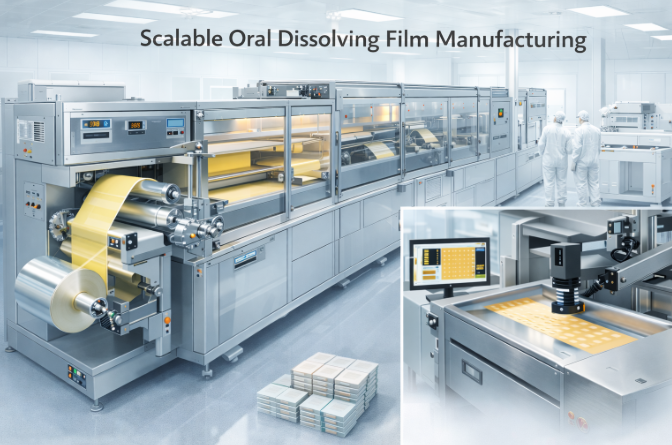
Manufacturing processes were designed using continuous roll-to-roll principles, allowing steady-state operation and reduced batch-to-batch variability. Critical parameters such as coating speed, solution viscosity, and drying temperature were defined within scalable operating windows [3].
Equipment Selection and Configuration
Industrial-scale ODF machines incorporating precision coating heads, multi-zone drying systems, and servo-controlled web handling were employed. Equipment configurations were selected to support incremental capacity expansion without fundamental process changes [4].
Environmental and Process Control
Production environments maintained controlled temperature and humidity to ensure film integrity and reproducibility. Real-time monitoring of critical parameters enabled rapid correction of deviations during scale-up [5].
Measures
Throughput and Yield
Scalability was assessed by measuring output rate, yield, and waste levels at increasing line speeds and production volumes [6].
Product Quality Attributes
Key quality metrics included film thickness uniformity, content uniformity, disintegration time, and mechanical strength, evaluated across multiple production scales [7].
Operational Robustness
Downtime frequency, maintenance intervals, and changeover efficiency were tracked to evaluate long-term manufacturing stability [8].
Results
Scalable manufacturing configurations demonstrated stable operation across a wide range of production speeds. Product quality attributes remained within predefined specifications as throughput increased, while yield improved due to reduced handling and automation. Environmental control and inline monitoring were critical to maintaining consistency during extended production runs.
Discussion
Effective scale-up of ODF manufacturing depends on designing processes and equipment with scalability in mind from the outset. Overly optimized laboratory conditions often fail under industrial constraints, whereas robust, standardized processes tolerate variability and enable reliable expansion. The findings highlight the importance of aligning formulation, equipment, and quality systems to achieve sustainable scalability [9].
Conclusion
Scalable oral dissolving film manufacturing is achievable through continuous processing, precise equipment control, and integrated quality systems. By adopting a scale-oriented design philosophy, manufacturers can transition efficiently from pilot to commercial production while maintaining product performance and regulatory readiness. This approach supports the long-term growth and global adoption of ODF-based products.
References
Dixit RP, Puthli SP. Oral strip technology: Overview and future potential. J Control Release. 2009;139(2):94–107.
Borges AF et al. Oral films: Current status and future perspectives. J Control Release. 2015;206:1–19.
Hoffmann EM et al. Manufacturing of orodispersible films: From lab scale to production. Eur J Pharm Biopharm. 2011;78(3):447–455.
Preis M, Breitkreutz J. Manufacturing considerations for oral films. Expert Opin Drug Deliv. 2017;14(6):1–12.
World Health Organization. WHO guidelines on good manufacturing practices (GMP).
Nakajima S. Introduction to TPM. Productivity Press.
Cilurzo F et al. Fast dissolving films: Mechanical and technological properties. Eur J Pharm Biopharm. 2008;70(3):895–900.
ICH Q8(R2). Pharmaceutical Development.
Morales JO, McConville JT. Manufacture and characterization of oral films. Eur J Pharm Biopharm. 2011;77(2):187–199.
Previous:Oral Dissolving Film Manufacturing at GMP Standard
Next:No Information