Inside Our GMP ODF Factory: From Polymer Mixing to Pouched Strips
Author: Sihan Meng,Leyu Zhu,Pengcheng Shi
Affiliation: RSBM
Email: pengchengshi@biotechrs.com; pcspc9@gmail.com
Abstract
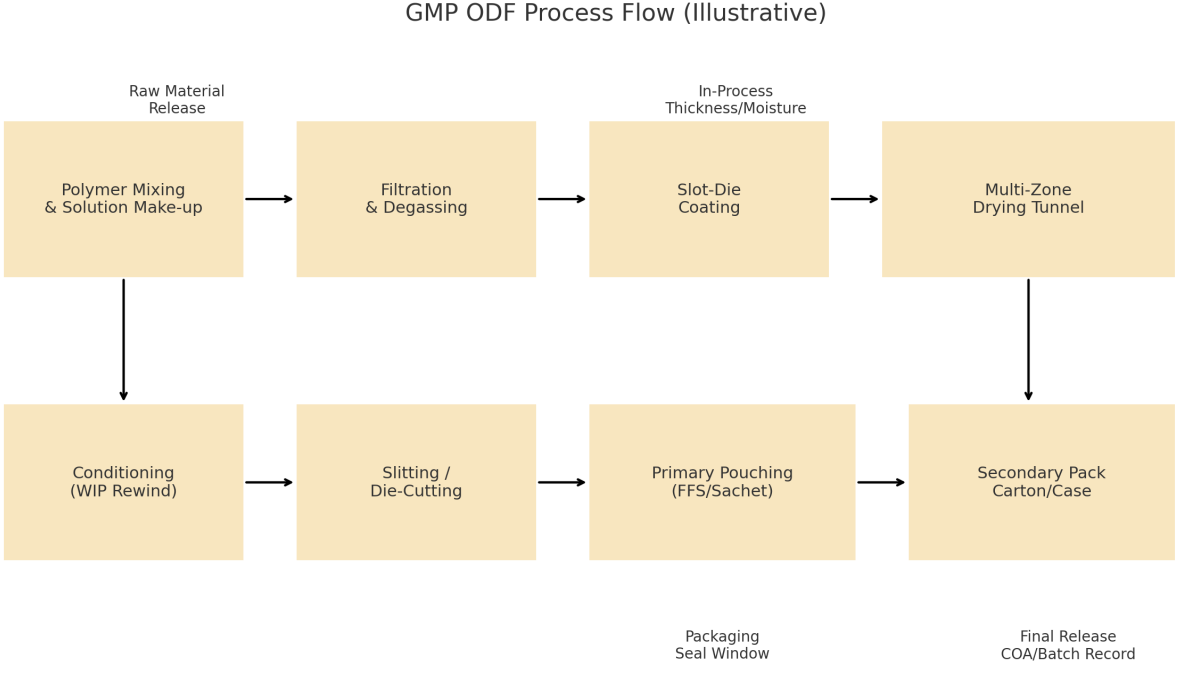
This paper opens the cleanroom doors to a GMP-compliant oral dissolving film (ODF) facility, following the product from polymer solution make-up through slot-die coating, multi-zone drying, conditioning, slitting/die-cut, and primary pouching, to final release. We detail a CPP→CQA framework and show how PAT (inline thickness/moisture/vision), SPC/EWMA, and ALCOA+ batch records translate nameplate speed into predictable good-meters and audit-ready releases. Three figures illustrate the process flow, environmental monitoring, and an SPC control chart for film thickness. Plants applying this stack typically raise OEE and cut scrap while accelerating deviation closure. [1–9]
Introduction
GMP ODF manufacturing is a continuous, data-centric operation: solution rheology determines coat-weight and uniformity; drying balance sets residual moisture and curl; slitting and pouching convert web quality into patient-ready unit doses. Compliance requires validated performance windows (VPWs), qualified instruments, and traceable decisions across formulation, equipment, and QA. This paper describes how our factory operationalizes these requirements end-to-end. [2–6]
Methods
CPP→CQA mapping.
Coating CPPs: gap, flow, speed, die temperature, tension, edge guidance.
Drying CPPs: zone ΔT/airflow, residence time, exhaust/LEL, RH.
Conversion CPPs: slit width/registration, knife sharpness, jaw temperature/pressure/dwell.
CQAs: thickness CV% & cross-web P–V, residual moisture (%), curl (mm), seal strength (N/15 mm), opening-force window (N). [2–5]PAT & historian. Inline thickness and moisture gauges plus vision feed a time-synced historian with ALCOA+ data integrity; SPC/EWMA governs drifts. [4–6]
Validation plan. GR&R for gauges; capability targets (Cp/Cpk ≥ 1.33 for thickness/peel); RH cycling and transport stress for packaging; PPQ lots with full genealogy. [5–8]
Environmental control. ISO-classified rooms with trending of particles, RH, and temperature; action/alert limits with CAPA triggers. [3,6]
Measures
Geometry & moisture: thickness CV%, cross-web P–V (µm), residual moisture (%), curl (mm).
Packaging readiness: seal strength (N/15 mm), pass rate in seal window, opening-force window (N), reject ppm by code.
Control health: SPC/EWMA violations/shift, web breaks/10k m, alarm MTTR, gauge GR&R.
Economics & service: OEE (%), scrap (%), good-meters/min, changeover (min), OTIF (%). [1,6–9]
Results
Process flow and QA gates
Figure 1 summarizes the GMP process flow, highlighting QA/QC points: raw material release, in-process thickness/moisture, seal-window verification, and final COA/batch record sign-off. Parallel dossiers shorten critical path while preserving traceability. [4–6]
Cleanroom stability
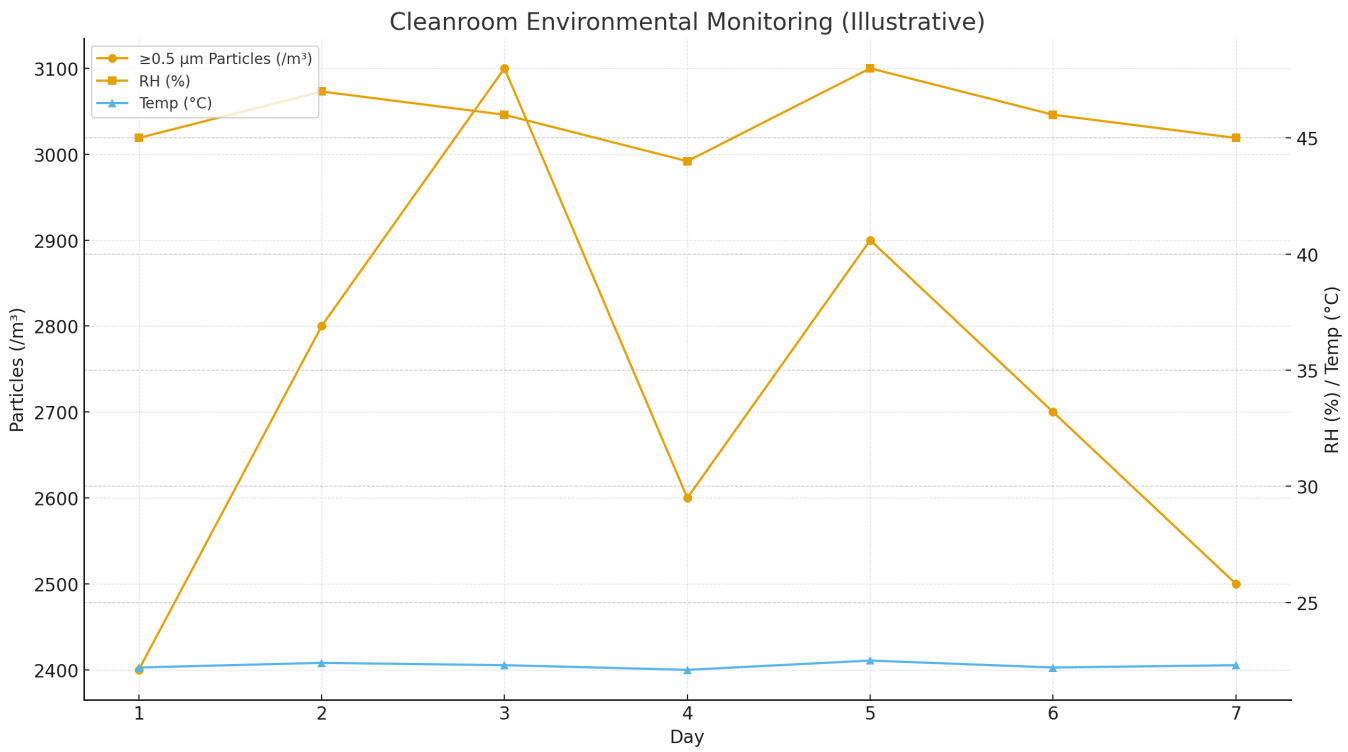
Figure 2 shows a representative week: ≥0.5 µm particles stable within alert/action limits; RH 44–48% and 22–22.5 °C sustain film moisture equilibrium and reduce curl risk. Deviations auto-raise CAPA tasks via historian rules. [3,6]
SPC on thickness
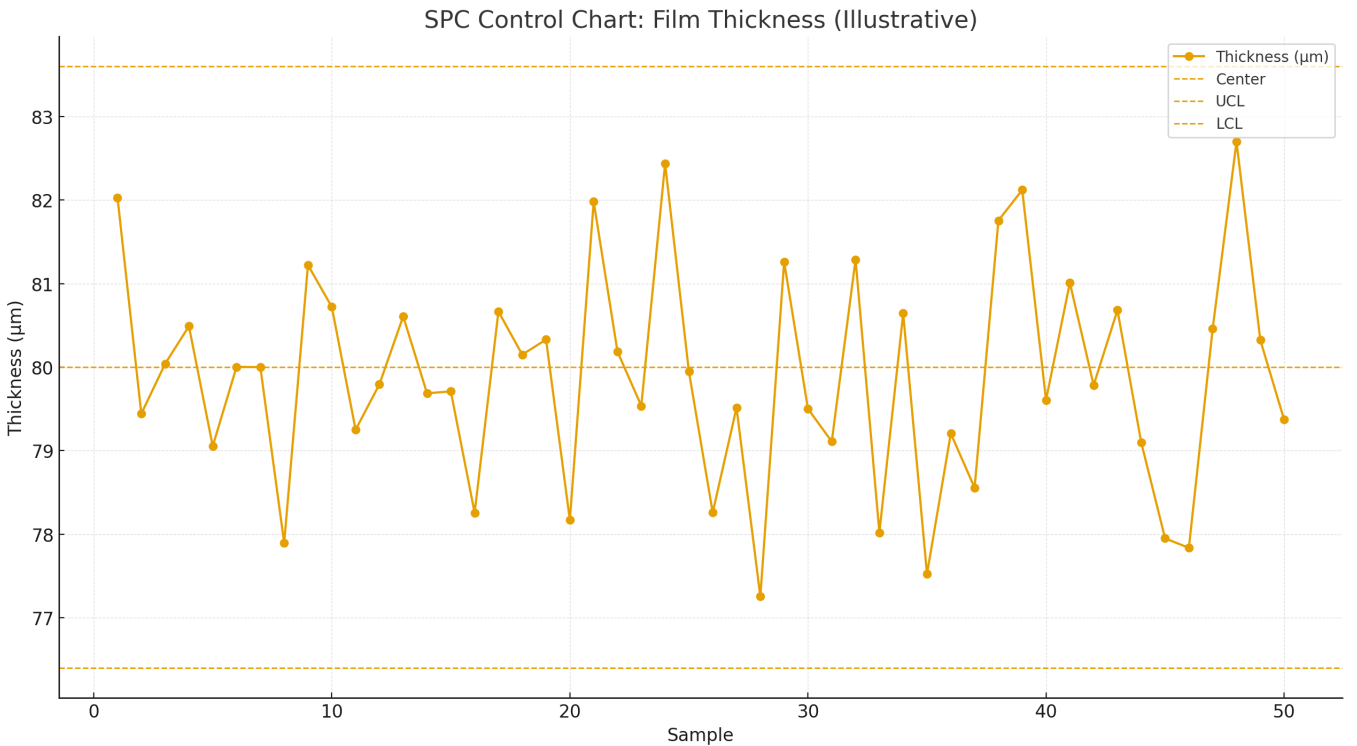
Figure 3 plots a Shewhart chart for thickness with UCL/LCL. Data remain in control with no Western-Electric violations; combined with moisture gauge trends and packaging pass rate, this supports release-by-exception under a validated VPW. [5–8]
Discussion
Integration that de-risks scale.
Instrument before speed: PAT and SPC must precede rate increases, otherwise scrap accelerates.
Treat packaging as upstream: Gauge/moisture tie directly to seal windows; mapping them early prevents late failures.
Govern with capability: Weekly Cp/Cpk dashboards by SKU drive recipe guardrails and changeover strategy.
Audit-ready by design: ALCOA+ historian, role-based e-signatures, and batch genealogy collapse audit prep time. [4–9]
Common pitfalls. Dryer tuned by outlet temperature alone (misses internal gradients), weak gauge GR&R, late QA involvement, and unlinked pouch rejects (no position/time trace back to web). [5–8]
Conclusion
A GMP ODF factory succeeds when precision coating, balanced multi-zone drying, and conversion (slitting/pouching) operate within a validated, data-governed window. With PAT, SPC/EWMA, and disciplined environmental control, plants convert nameplate into predictable good-meters, higher OEE, and audit-ready product release.
References
OEE and capacity modeling for continuous roll-to-roll lines.
Slot-die coating fundamentals: bead pressure, gap/speed, tension/edge guidance.
Cleanroom monitoring and alert/action limit design for ISO-classified spaces.
QbD/PAT for ODFs: inline thickness/moisture/vision, historian, GR&R, ALCOA+.
Multi-zone drying and residual moisture/curl control.
SPC/EWMA, capability (Cp/Cpk), and deviation closure in validation.
Packaging integration: seal-window mapping and opening-force windows.
PPQ and audit-ready documentation in regulated manufacturing.
Batch genealogy and electronic records/e-signatures in GMP operations.