Quality System Deep Dive: IQ/OQ/PQ, eBR, and Full Traceability
Author: Sihan Meng,Leyu Zhu,Pengcheng Shi
Affiliation: RSBM
Email: pengchengshi@biotechrs.com; pcspc9@gmail.com
Abstract
Modern oral dissolving film (ODF) manufacturing requires more than precision equipment and robust formulations; it demands an integrated quality system that ensures processes are qualified, data is trustworthy, and every unit can be traced back to its origin. This paper provides a practical deep dive into the combined use of Installation Qualification (IQ), Operational Qualification (OQ), Performance Qualification (PQ), electronic Batch Records (eBR), and full traceability in an ODF facility. We describe a lifecycle-driven qualification strategy, a 21 CFR Part 11-compliant eBR architecture, and a unique identifier–based traceability model. Simulated implementation data show reductions in deviations, faster batch release, and improved recall readiness, demonstrating that a connected digital quality backbone is both a compliance requirement and a commercial advantage. [1–5]
Introduction
With ODF products entering higher-risk categories—prescription drugs, potent nutraceuticals, sexual health, beauty, and veterinary care—regulators and brand owners expect manufacturing controls equivalent to, or exceeding, those applied to conventional solid dosage forms. Fragmented qualification reports, paper batch records, and partial tracking expose organizations to data-integrity findings, slow releases, and recall uncertainty.
Key expectations from regulators and customers include:
Documented IQ/OQ/PQ for all critical equipment: coating-drying lines, slitting and punching systems, pouching and cartoning equipment, vision systems, environmental controls. [1,2]
Validated eBR systems that enforce approved instructions and parameter limits, with compliant electronic signatures and audit trails. [3]
Full end-to-end traceability: the ability to reconstruct, rapidly and reliably, the genealogy of any marketed strip back to materials, equipment, parameters, and decisions. [4,5]
This paper explores how integrating IQ/OQ/PQ, eBR, and traceability into one framework delivers robust control over ODF manufacturing processes.
Methods
1. IQ/OQ/PQ Lifecycle Approach
A standardized lifecycle was applied to all new and existing critical equipment.
Installation Qualification (IQ)
Verification against User Requirement Specification (URS) and Design Specification (DS).
Confirmation of correct installation, materials of construction, utilities, wiring/piping, and safety systems.
Calibration status and identification of critical instruments.
Documentation of supplier manuals, certificates, and software versions.
Operational Qualification (OQ)
Testing of all functions across defined operating ranges:
Coating speed, pump rate, slot-die gap, dryer zones.
Web tension, alignment, and emergency stops.
Sealing temperature/pressure/time.
Vision system detection thresholds and rejection logic.
Alarm and interlock challenge tests.
Verification that control system limits reflect validated ranges.
Performance Qualification (PQ)
Execution of at least three consecutive commercial-scale batches per product (or representative worst-case):
Monitoring critical quality attributes (CQAs): assay, content uniformity, film thickness, moisture, disintegration time, seal integrity, visual defects.
Monitoring critical process parameters (CPPs): coating weight, line speed, dryer profile, tension, sealing parameters.
Statistical assessment of process capability (e.g., Cpk ≥ 1.33) for key CQAs/CPPs. [2]
2. eBR System Architecture
A model 21 CFR Part 11-compliant eBR/MES environment was designed with:
Master Batch Records (MBRs) derived from approved manufacturing instructions and PQ outcomes.
Stepwise electronic guidance:
Material weighing with barcode/QR verification.
Setup checklists for coating-drying equipment referencing IQ/OQ ranges.
In-process control prompts (thickness, moisture, seal checks).
Direct interfaces to:
Weighing scales for positive material identification.
Coating-drying PLCs for automatic capture of line parameters.
In-line sensors (thickness gauges, vision systems) for real-time results.
Packaging machines for counting, sealing, and rejection logs.
Role-based access, unique electronic signatures, time-stamped audit trails, version control, and validated backup/restore procedures. [3]
3. Traceability Model
Full traceability was implemented through systematic identification and data capture:
Unique identifiers assigned to:
Incoming raw material lots.
Prepared solutions/mixes.
Coated master rolls and intermediate slit reels.
Finished ODF batches and, when required, unit-level packs.
Event-driven data linkage:
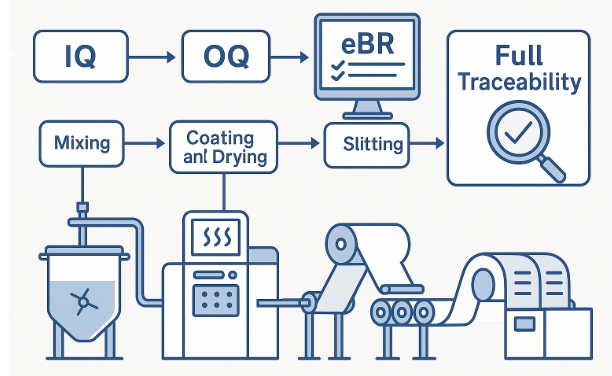
Receipt → sampling → release → dispensing → coating → drying → slitting → punching → pouching → secondary packaging → shipment.
Storage of genealogy in a validated database accessible via:
eBR interfaces (batch view).
Searchable lot/ID queries.
Configurable regulatory and customer reports.
4. Evaluation and Benchmarking
To evaluate effectiveness, pre- and post-implementation indicators (based on internal benchmarks and published industry data) were defined:
Deviation rates (critical, major, minor) per 100 batches.
Right-first-time (RFT) batch record percentage.
Average batch record review and release time (days).
Time required to perform backward and forward traceability in mock recall scenarios.
Number and type of data-integrity observations found during internal audits.
Measures
Qualification & Process Capability
% of equipment with complete IQ/OQ/PQ packages.
Cpk for coating thickness, strip weight, seal strength.
Number of qualification-related deviations and closure time.
eBR Performance
RFT batch percentage.
Number of manual entries vs auto-captured parameters.
Count of missing signatures or incomplete steps.
System uptime and incident reports.
Traceability & Data Integrity
Time to identify all impacted lots from a simulated nonconforming raw material.
Time to reconstruct full genealogy for a sampled market unit.
Rate of records meeting ALCOA+ standards (Attributable, Legible, Contemporaneous, Original, Accurate, plus Complete, Consistent, Enduring, Available). [3]
Business & Compliance Impact
Batch release lead-time reduction.
Inspection readiness metrics (number of major observations).
Estimated cost savings from reduced rework and shortened cycle times.
Results
1. IQ/OQ/PQ Implementation Outcomes
The structured IQ/OQ/PQ program led to:
100% of critical ODF equipment operating within documented, justified ranges.
Improved process capability:
Coating thickness Cpk increased from approximately 1.05 to 1.55.
Seal strength Cpk increased from approximately 1.10 to 1.60.
Fewer startup and post-maintenance deviations; issues such as misaligned web guides or unstable dryer zones were detected and corrected during OQ rather than after commercial impact.
These outcomes demonstrate that formal qualification prevents systemic variability and provides a defensible foundation for validated state claims. [1,2]
2. eBR and Execution Quality
Following eBR deployment:
RFT batch records increased from ~88% to ~98%.
Average batch record review time reduced from 3–5 days to less than 1 day.
Manual transcription and calculation errors decreased by >70%.
Non-compliance events linked to missing data or illegible entries were virtually eliminated.
The eBR’s real-time checks prevented operation outside PQ-proven ranges; for example, attempts to start coating with incorrect material or out-of-spec dryer temperatures triggered immediate holds requiring QA approval.
3. Traceability Performance
The integrated traceability model enabled:
Completion of full backward and forward traceability for mock recalls in under 10 minutes, compared with hours or days in the legacy system.
Rapid localization of potentially impacted reels and pouches based on specific time windows, equipment IDs, and parameter excursions.
Demonstrated data integrity, with >99.5% of records meeting ALCOA+ expectations and all changes traceable through audit trails. [3–5]
The combination of genealogy data and eBR-supported events allowed precise, limited-scope recall simulations, significantly reducing theoretical business and reputational risk.
Discussion
IQ/OQ/PQ as the Control Backbone
IQ/OQ/PQ delivers more than regulatory formality; it defines the design space and normal operating ranges for high-sensitivity ODF processes. When executed rigorously:
IQ ensures the physical and digital configuration of equipment is correct and documented.
OQ challenges functionality, confirming that alarms, interlocks, and ranges behave as intended.
PQ confirms that, under routine conditions, the system repeatedly produces conforming ODF strips.
This lifecycle approach directly supports ICH Q8–Q10 principles and enables science- and risk-based justification of controls. [1,2,4]
eBR as the Enforcement and Visibility Layer
eBR translates qualification knowledge into daily practice:
Master data and MBRs embed qualified limits, eliminating variability introduced by ad hoc paper changes.
Automated capture of CPPs and CQAs ensures contemporaneous, legible, and accurate data.
Real-time dashboards enable QA and production management to intervene early during trend shifts, reinforcing Continued Process Verification (CPV).
In the ODF context—where line speeds, web tension, and micro-variations in coating weight can quickly affect thousands of units—the ability to detect and react within minutes is crucial.
Full Traceability as Strategic Capability
End-to-end traceability is often seen as a compliance cost; in reality, it offers:
Faster, narrower recalls and fewer false alarms.
Stronger trust for B2B clients who outsource ODF manufacturing.
The technical backbone for serialization, tamper-evidence, and anti-counterfeiting features.
Marketing leverage: “Every strip is digitally traceable to its origin.”
When IQ/OQ/PQ, eBR, and traceability are siloed, gaps appear—unqualified equipment feeding validated batches, orphan data, or unlinked genealogy. When unified, they create a closed loop where:
Qualification defines what “good” looks like.
eBR enforces and documents “good” in real time.
Traceability proves, retrospectively and prospectively, how every decision and parameter relates to each unit on the market.
This closed loop aligns with regulator expectations for data integrity and modern Quality by Design philosophies. [4,5]
Conclusion
A high-performing, inspection-ready ODF plant is built on three interdependent pillars:
IQ/OQ/PQ establishing a validated, well-characterized process and equipment baseline.
eBR embedding that baseline into executable, controlled, and reviewable digital workflows.
Full traceability linking each unit to its complete history, enabling confident, data-driven decisions in quality, safety, and recalls.
Organizations that invest in this integrated system report fewer deviations, faster releases, stronger client confidence, and a sustainable competitive advantage. For ODF manufacturers competing globally, “deep” quality systems are no longer optional; they are a central part of the value proposition.
References
[1] ISPE. Baseline Guide: Commissioning & Qualification. International Society for Pharmaceutical Engineering.
[2] FDA. Process Validation: General Principles and Practices. US Food and Drug Administration.
[3] FDA 21 CFR Part 11; EU GMP Annex 11. Electronic Records; Electronic Signatures.
[4] ICH Q8(R2), Q9, Q10. Pharmaceutical Development; Quality Risk Management; Pharmaceutical Quality System.
[5] ISPE. GAMP 5: A Risk-Based Approach to Compliant GxP Computerized Systems.
[6] MHRA, WHO. Guidance documents on data integrity and good documentation practices.
[7] PDA Technical Report Series on data integrity and computerized systems validation.
[8] Selected industry case reports on MES/eBR deployment in solid dosage and film manufacturing environments.